How to Sell Software to Shopify Merchants
A practical direct-to-merchant playbook for Shopify apps and ecommerce SaaS: choose the right channel, define the merchant segment, use defensible signals, and qualify the conversation.
Do not target “Shopify stores” as one market. Choose a merchant segment with a plausible problem, confirm that sales-assisted acquisition fits the product economics, research legitimate public business signals, contact the right role with a careful reason for outreach, and measure qualified conversations rather than raw replies.
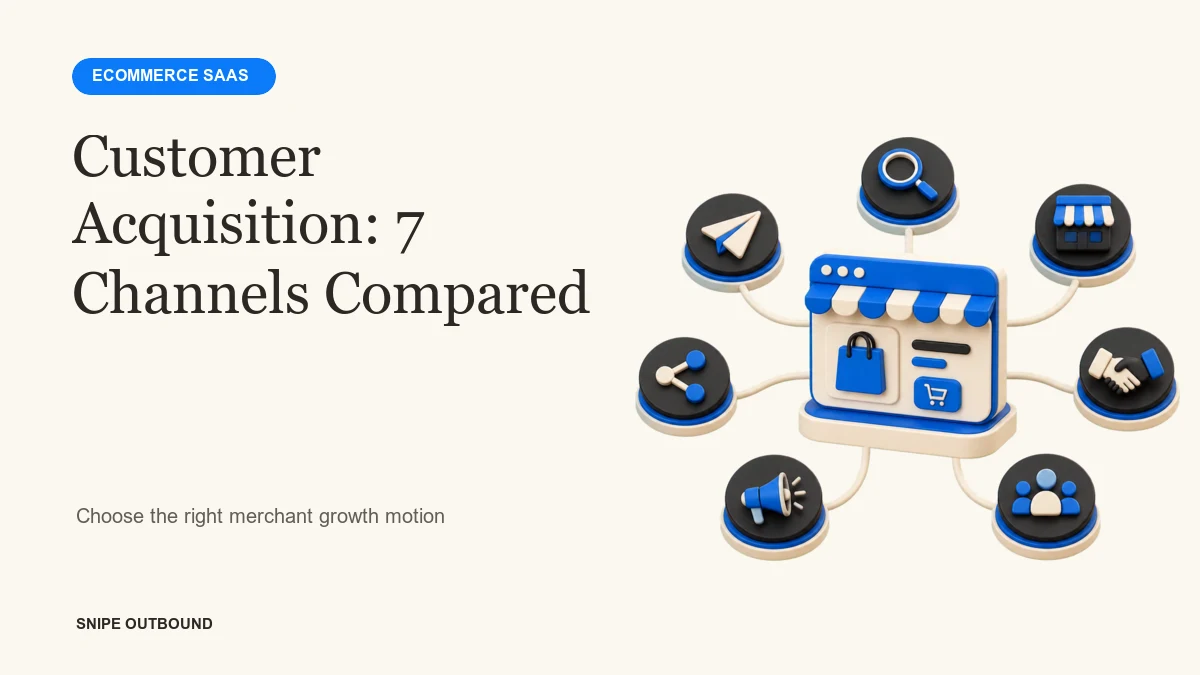
A Shopify app can grow through App Store discovery, product-led conversion, content, partners, referrals, paid acquisition, direct sales, or a combination. Direct outreach is one option, not a default. It fits best when the product has enough value or implementation complexity to justify research and a sales conversation.
Shopify itself distinguishes public App Store distribution from limited-visibility and custom-app paths. Fully visible apps can appear in App Store search, category pages, and third-party search results; limited-visibility apps do not receive those discovery surfaces. Review Shopify's current app-listing visibility documentation before building an acquisition plan around marketplace traffic.
1. Decide whether you should sell through a conversation
Start with the buying motion, not the contact list.
| Product situation | Likely primary motion |
|---|---|
| Low-priced utility, fast setup, broad merchant audience | Marketplace and product-led growth |
| Clear problem with searchable demand | App Store optimization, content, and search |
| Agency-influenced implementation | Partner and referral motion |
| Higher-value product requiring diagnosis, integration, or change management | Sales-assisted acquisition, including outbound where appropriate |
| Enterprise or Shopify Plus workflow with multiple stakeholders | Account-based sales and partner support |
If merchants can understand, install, activate, and pay without human help, improve those conversion steps before adding sales labor. Shopify calls the app listing one of an app's most important marketing assets; its current App Store best-practices guide is the appropriate source for listing requirements and guidance.
2. Define a merchant segment, not a platform
“Shopify merchant” includes very different businesses. A single-product founder, a multi-brand operator, a subscription business, a wholesale manufacturer, and a Shopify Plus retailer do not share one buying committee or one problem.
Build the segment in layers:
- Platform context: Shopify storefront, Shopify Plus, multi-store, or a relevant connected system.
- Business model: DTC, B2B commerce, subscription, marketplace, omnichannel, or another defined model.
- Operating condition: catalog complexity, international selling, fulfillment model, promotion frequency, team structure, or another observable fit criterion.
- Problem ownership: founder, ecommerce lead, operations, retention, marketing, finance, support, or technical leadership.
- Commercial fit: geography, maturity, likely implementation path, and the economics needed to support the product.
- Exclusions: existing customers, partners, open opportunities, competitors, irrelevant store types, and businesses you should not contact.
A segment is useful only when it explains why the product is relevant and who can evaluate it.
3. Use store signals as research inputs—not private facts
Public business information can help prioritize research. Examples include the storefront's product category, public catalog, shipping regions, job postings, public campaigns, published integrations, press releases, or company announcements. Only use information you are permitted to collect and process.
A signal is evidence of context, not proof of pain or intent. A growing catalog does not prove inventory problems. A job opening does not prove budget. An observable integration does not prove dissatisfaction. Use conditional language and give the prospect room to correct the inference.
| Observed context | Responsible inference | Bad leap |
|---|---|---|
| Public expansion into another market | International operations may be becoming more complex | You are losing revenue because localization is broken |
| Ecommerce operations role advertised | The company may be investing in operating capacity | Your team cannot handle order volume |
| Large, changing public catalog | Catalog workflows may matter to this team | Your inventory data is inaccurate |
4. Map the problem to the right role
Store ownership and problem ownership are different. The founder may control software at a small brand, while a larger merchant may divide decisions among ecommerce, operations, retention, marketing, finance, support, security, procurement, and engineering.
- Contact the person accountable for the workflow your product changes.
- Include technical stakeholders when the product needs permissions, data access, or implementation.
- Include economic stakeholders when the contract or change has material commercial impact.
- Avoid contacting every executive at once; coordinated targeting needs suppression and stop rules.
5. Position the merchant-level problem
The first message should not attempt to explain the entire product. It should connect one relevant buyer situation to one credible problem and one understandable mechanism.
A useful structure is:
- state the specific, observable reason for contact;
- describe the plausible problem without pretending to know private data;
- explain how the product addresses it in concrete terms;
- use approved, relevant proof where available;
- ask a small question that lets the buyer confirm or reject relevance.
Our B2B offer-positioning framework separates the buyer, problem, consequence, mechanism, scope, proof, and CTA before the email is written. The ecommerce SaaS cold-email guide applies that reasoning to merchant acquisition.
6. Coordinate App Store and outbound conversion
Direct outreach often sends the buyer to the website, product page, or App Store listing. Those surfaces must tell the same story. A merchant who receives a narrow use-case message but lands on a generic “grow your store” page will have to reconstruct the relevance.
- Align the category and primary use case across the email, website, and listing.
- Make pricing, permissions, installation, trial, and support expectations understandable.
- Use only genuine reviews and approved customer evidence.
- Ensure installation and onboarding can deliver the promise made in acquisition.
- Track the handoff from conversation to evaluation, install, activation, payment, and retention.
Shopify's current requirements emphasize accurate listings and a seamless, secure installation flow. Read the official App Store requirements rather than relying on an old checklist.
7. Qualify the conversation before booking
Define a qualified conversation before outreach starts. Criteria may include the merchant type, role, operating condition, relevant problem, geographic or technical requirements, and willingness to evaluate the product. A reply is not automatically qualified, and an installation is not automatically retained revenue.
Track the full funnel:
- valid accounts and appropriate contacts;
- delivered messages and meaningful replies;
- positive conversations and disqualifications;
- qualified meetings and held meetings;
- product evaluations, installs, activations, paid conversions, and retained customers where applicable.
8. Know when to stop or change the motion
If researched conversations repeatedly show that the problem is not important, the role is wrong, or the product cannot support sales-assisted acquisition, change the premise rather than increasing volume. If buyers show interest but do not install or activate, the bottleneck may be the product, listing, onboarding, permissions, price, or implementation—not the outreach.
The Shopify install diagnostic locates those conversion failures. The stage-by-stage scale guide helps decide which constraint to address next.
Proof and service boundary
Terrific Live sells live-shopping software to ecommerce businesses. Its approved case study documents 301 interested replies all time and 100 demos booked in 64 days of sending. That is evidence from one documented engagement, not a universal benchmark for every Shopify app or merchant segment.
Snipe provides email-led outbound: approved targeting, prospect research, campaign copy, dedicated sending infrastructure, reply handling, qualification, and calendar booking. It does not manage App Store listings, generate marketplace reviews, run paid ads, automate LinkedIn, perform SEO delivery, or own product onboarding.