
Ecommerce SaaS Customer Acquisition: 7 Channels Compared
Commerce software is sold to merchants, not consumers. That difference changes the market, the message, the signals, and the acquisition channels that can work.
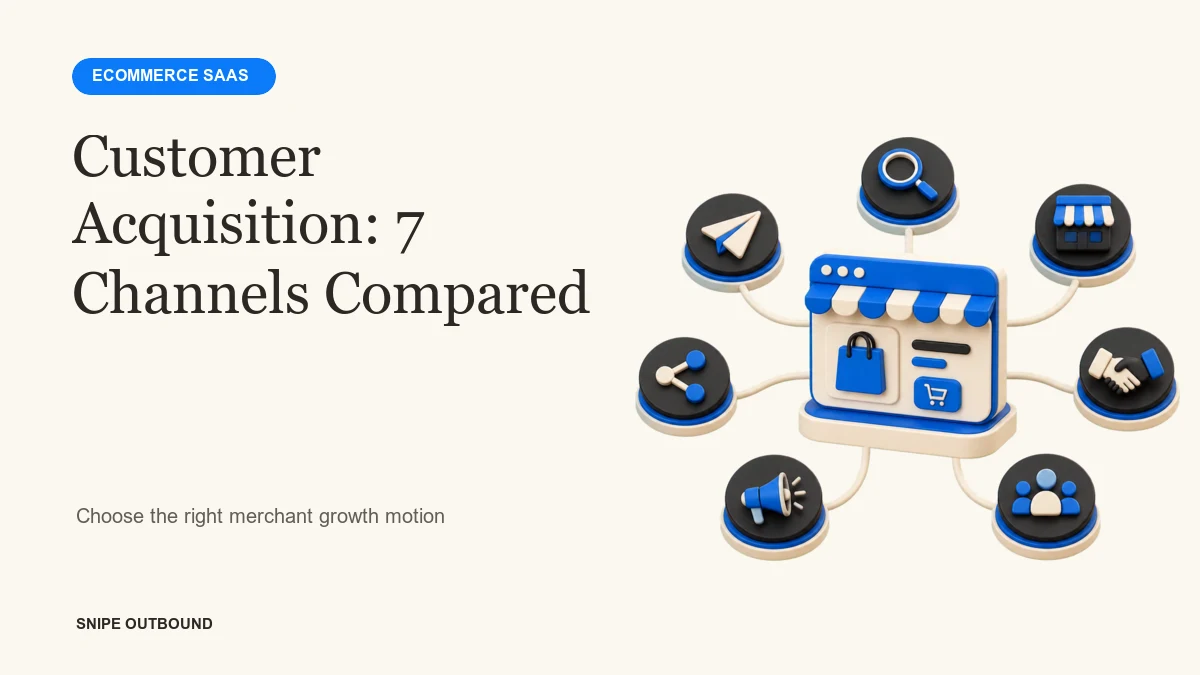
Choose acquisition channels from how merchants buy, your contract value, and how visible product fit is. App marketplaces capture existing demand. SEO compounds. Paid media buys speed. Partnerships borrow trust. Referrals monetize success. Community creates learning. Outbound creates conversations with exact-fit merchants.
Ecommerce SaaS customer acquisition often gets confused with ecommerce customer acquisition. They are different jobs.
A merchant uses paid social, email, search, influencers, retail media, and marketplaces to acquire shoppers. An ecommerce software company uses its marketplace listing, content, partners, referrals, communities, paid acquisition, and outbound to acquire merchants. The end buyer may be a Shopify founder, ecommerce director, growth lead, operations leader, or technical owner.
This guide applies to Shopify apps and plugins, WooCommerce extensions, Shopware plugins, BigCommerce apps, and software sold directly to DTC brands or retailers. The platform language changes. The channel economics do not. For the category map and platform-specific routes, start at the ecommerce software growth hub.
Choose channels from the buying motion
Start with four questions:
- Is the problem already searched for? Existing category demand favors marketplaces and search.
- Can fit be observed before a conversation? Visible store, stack, catalog, and growth signals make targeted outbound possible.
- How much help is required to buy? A simple low-price plugin can convert self-serve. A multi-store or enterprise platform may need a demo, security review, migration, and implementation plan.
- What is a customer worth? The acquisition effort must fit expected gross profit and retention, not vanity install volume.
There is no universally best channel. There is a best next channel for the current product, buyer, and stage.
The seven ecommerce SaaS acquisition channels
| Channel | Speed | Control | Best fit |
|---|---|---|---|
| 1. App marketplace | Medium | Low | Products in an established searched category |
| 2. SEO and content | Slow | High | Problems merchants research before buying |
| 3. Paid acquisition | Fast | Medium | Proven conversion and enough margin to buy demand |
| 4. Agency and tech partnerships | Slow | Medium | Products influenced by implementers or adjacent tools |
| 5. Referrals and product-led loops | Medium | Medium | Apps with visible, shareable customer value |
| 6. Founder/community motion | Medium | Medium | Early products still learning the market |
| 7. Targeted outbound | Fast | High | Products with observable fit and sales-supporting value |
1. App marketplace discovery
A marketplace places the product where merchants already look for software. For Shopify apps, the listing also feeds discovery beyond classic search. Shopify says descriptions, features, pricing, and reviews support App Store browsing, recommendations, in-admin discovery, and Sidekick.
Marketplace discovery works best when the category is understood and the app can communicate value quickly. The listing needs specific positioning, accurate screenshots, clear pricing, reliable onboarding, support, and honest reviews. Shopify explicitly prohibits incentivized or selectively positive review requests; follow its current review guidance.
Constraint: distribution is rented. Rankings, policies, and category competition are not under your control.
2. Problem-led SEO and content
Search works when merchants name the problem before they know the product. A returns platform can teach returns operations. A merchandising app can explain collection logic. A subscription tool can cover churn and payment recovery.
Build content around the buyer’s job, not around synonyms for the same article. “Shopify app marketing,” “Shopify plugin marketing,” and “how to promote a Shopify app” often share intent and belong on one strong page. Separate pages should answer separate decisions, such as acquisition-channel selection, App Store conversion, outbound targeting, or scaling by stage.
Constraint: content compounds slowly and can attract merchants who will never fit. Connect each article to a product use case and a clear next step.
3. Paid acquisition
App Store search ads, paid search, and social can create fast learning. They also multiply whatever funnel already exists. Before scaling spend, verify that qualified visitors install, activated accounts convert, and paid cohorts retain.
Use paid media to answer a defined question: can this category keyword acquire retained merchants below the acceptable cost? Can this audience-message pair create demos? Do not treat impressions as evidence of demand.
Constraint: a weak listing or onboarding flow turns spend into faster churn.
4. Agency and technology partnerships
Shopify agencies, systems integrators, fractional ecommerce leaders, and complementary apps influence the tools a merchant adopts. One trusted partner can create introductions across many stores.
Partnerships become productive when the partner can recognize fit. Give them a concrete trigger, ideal merchant profile, implementation boundary, proof, and referral path. “Send anyone who needs our app” is not enablement.
Constraint: partner channels take time and often depend on a small number of relationships.
5. Referrals and product-led loops
Some commerce products naturally create a loop. Agencies reuse an app across clients. Merchants recommend a tool in operator groups. Customers share an output that exposes the product. A multi-brand owner rolls it into another store.
Ask for referrals after measurable value, make the introduction easy, and never confuse a referral program with review incentives. Product reviews must remain neutral and unincentivized under Shopify’s policies.
Constraint: referrals cannot rescue a product that has not created a result worth discussing.
6. Founder-led community and education
Early in the journey, direct contact with merchants is a learning system. Useful participation in platform communities, operator groups, webinars, office hours, and partner events can reveal buyer language and objections before a scalable channel exists.
Teach the workflow your product supports. Do not turn every answer into a pitch. The objective is to become associated with a problem and to learn which merchants experience it intensely enough to act.
Constraint: founder credibility is hard to delegate and community promotion without contribution damages trust.
7. Targeted outbound to merchants
Outbound is the highest-control channel when merchant fit is visible. Ecommerce stores expose more relevant context than a generic company database:
- platform and installed technology;
- product category, catalog breadth, and merchandising structure;
- countries, currencies, locations, and multi-store complexity;
- active advertising, product launches, hiring, and expansion signals;
- public evidence of a workflow your product improves.
The message should name an observable situation, not invent private performance data. Connect one real signal to one plausible problem, show credible proof, and ask for a small next step. Our cold email for ecommerce SaaS guide covers the execution layer.
Constraint: broad lists and templated copy burn a small market quickly. Use a narrow ICP and dedicated sending infrastructure.
How to build an ecommerce merchant ICP
A useful ICP is a set of filters tied to product value. Start with the problem and work backward to visible evidence.
| Product type | Potential fit signals |
|---|---|
| Personalization or search | Large catalog, varied collections, meaningful traffic proxies, existing merchandising tools |
| Returns or post-purchase | Return-prone categories, multi-country operations, policy complexity, order-volume proxies |
| Subscription or retention | Replenishable products, subscription stack, repeat-purchase category, active lifecycle marketing |
| B2B or wholesale commerce | Dealer or retailer program, gated pricing, bulk ordering, multi-location buyers |
| Creative or ad workflow | Active ad library, frequent launches, broad SKU set, in-house growth hiring |
These are examples, not universal filters. Validate that each signal predicts need for your specific product. Remove any filter that merely makes a list larger.
Use offer positioning that matches the channel
A self-serve marketplace promise should explain the product and time to value quickly. A partner pitch should explain when to refer and what happens after. An outbound offer should make the conversation worth the merchant’s attention.
Strong ecommerce SaaS positioning usually includes:
- the specific merchant or operating situation;
- the workflow or problem being improved;
- the product’s mechanism, in plain language;
- the credible outcome or proof available;
- the scope and limitations, without inflated guarantees.
“Grow your Shopify store” is too broad for almost every app. “Reduce manual catalog cleanup for stores carrying thousands of variants” gives a merchant a reason to keep reading—if that is truly what the product does.
Proof from an ecommerce SaaS outbound motion
Terrific Live sells live-shopping and shoppable-video software to DTC brands, retailers, and media publishers. Snipe built the merchant list, researched prospects, wrote the outreach, ran dedicated sending infrastructure, handled replies, and booked meetings. The campaign produced 301 interested replies all time and 100 demos booked in 64 days of sending of sending. Read the full case study.
“Honestly, I was skeptical at first. We had tried other agencies and channels before and most of it never really scaled, so I did not expect much. They ran the whole system on their own domains and never touched ours, so our main email was never at risk. The meetings that come in are actually qualified, so my sales team stopped doing the manual back and forth and now they just show up and sell. I can see every lead and every meeting in real time, so it never feels like a black box. The qualified meetings just keep coming in.”Lotan KimHead of GTM, Terrific Live

A channel mix for the next 90 days
Keep one compounding channel
Maintain the App Store listing, useful content, or partner motion that builds durable discovery. Improve it on a fixed cadence rather than restarting the strategy every week.
Add one controlled acquisition test
Choose paid acquisition or targeted outbound—not both—so the team can learn from a clear audience, message, offer, and conversion path.
Measure cohort quality
Compare activation, paid conversion, retention, support burden, and expansion by source. A smaller channel that produces retained, well-fitting merchants can be more valuable than a large source of installs.
Set a decision date
At the end of 90 days, decide whether to scale, repair, or stop the channel. Do not preserve an activity because the team invested effort in launching it.
Want a controlled merchant-acquisition channel?
Snipe handles targeting, research, cold-email infrastructure, replies, qualification, and booking for ecommerce SaaS.
Related service: If you want Snipe to operate this motion with your team, review email-led outbound for ecommerce software companies.