
Cold Email for Ecommerce Agencies: From Store Signals to Clients
How Klaviyo, paid ads, CRO, Shopify and Amazon agencies can turn account research into relevant outreach and better sales conversations.
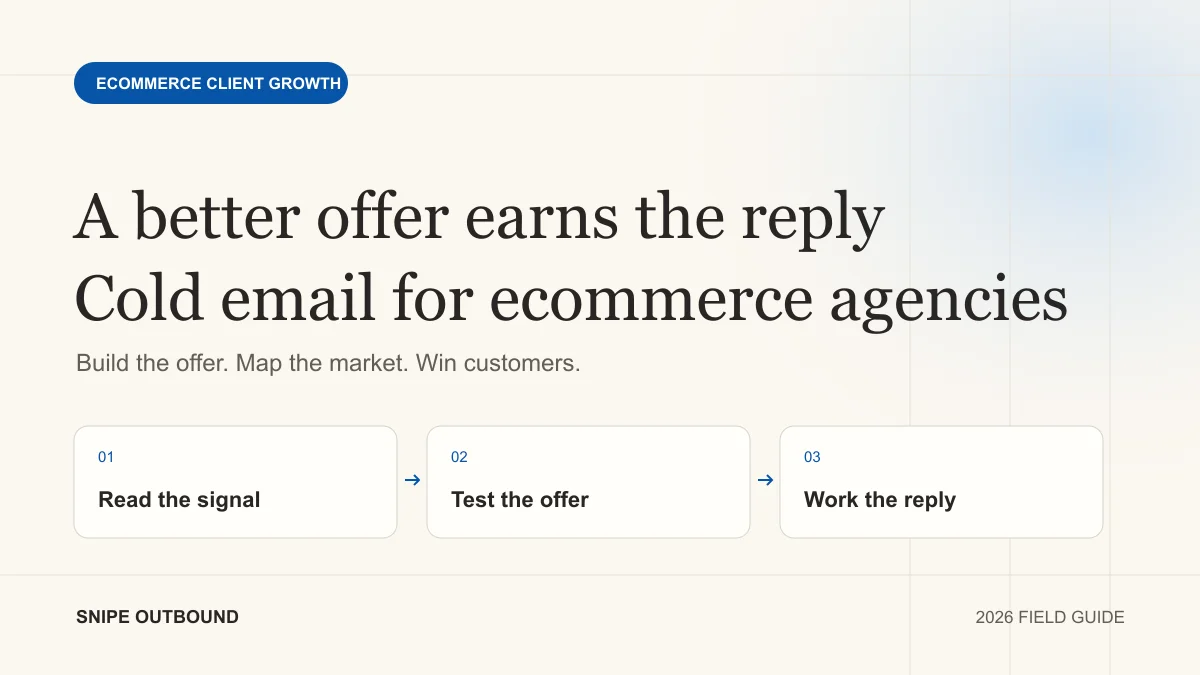
Cold email for ecommerce agencies works best as an offer-and-market system: choose a serviceable segment, identify a relevant store signal, make a specific offer, and work each interested reply through to a qualified sales conversation. Personalization makes the message relevant. The offer gives the buyer a reason to answer.
This applies to agencies selling Klaviyo and email marketing, paid ads, creative, CRO, Shopify development or Amazon services. The buyer is the ecommerce brand. The objective is new agency clients, not email volume.
Why does ecommerce agency outreach often sound interchangeable?
“We help brands grow” could describe almost every agency in the inbox. Adding a founder's name or a compliment about a product does not explain why your service matters now.
Before changing the opening line, diagnose three separate issues:
- Wrong account: the brand cannot use or support the work you sell.
- Weak reason: the message names a service without connecting it to a current situation.
- Heavy first step: you ask for a sales call before giving the buyer a useful reason to engage.
A better opener cannot repair all three. Build the segment and offer first, then write the message around them.
How do you turn a store signal into a relevant offer?
A signal should narrow the account list and shape the conversation. It should not become an unsupported claim about a brand's finances or performance. Keep a record of what you observed, where you found it and when you checked it.
| Agency service | Possible research signal | Question to investigate |
|---|---|---|
| Klaviyo or email marketing | An observed gap in a customer email journey | Is the gap real, relevant and within your delivery scope? |
| Paid ads or creative | Ads repeatedly using the same visible creative | Does the brand need additional creative testing capacity? |
| Amazon services | No verified Amazon presence for the brand | Is Amazon expansion commercially and operationally appropriate? |
| CRO or development | Thin product information or confusing navigation | What specific buying decision could the store explain better? |
These are research starting points. Seeing one ad does not establish a brand's creative strategy. Failing to find a storefront does not prove that it has no marketplace presence.
Use the free Ecommerce Market Map Builder to keep account-fit evidence separate from timing signals, then connect both to a client-approved offer.
What does a strong cold email offer look like?
Snipe's Cold Offer Test asks whether a busy buyer would accept the offer from a stranger, whether the value and delivery timing are clear, whether it is about their world, and whether the client can deliver it easily.
The following patterns are illustrative, not tested campaign claims or ready-to-send promises. An agency should only use a pattern after defining an asset it genuinely provides and confirming the account observation.
- Email agency: use a documented customer journey issue to introduce an existing, tightly scoped planning asset. Keep the promise about the analysis delivered, not an invented revenue uplift.
- Paid ads agency: connect an observed creative pattern to a defined testing plan the agency can actually provide. Do not claim fatigue or poor performance without evidence.
- Amazon agency: invite a discussion of whether marketplace expansion fits the brand's products and constraints. Do not present hypothetical marketplace revenue as money already lost.
The offer should have a clear boundary. A vague free consultation still leaves the buyer doing the work of deciding why to attend. A large unpaid project creates a different problem for your agency.
How should you write the actual cold email?
Give each message one job. A practical structure is an observation, a relevant offer, appropriate proof and one next step. You do not need all the details of your service in the first email.
- Observation: a checked fact about the account, in plain language.
- Relevance: why that fact could matter to the buyer's current priorities.
- Offer: the specific first step you have already defined.
- Proof: a truthful example from comparable work, with its limits clear.
- Question: one easy decision, rather than several competing requests.
Do not borrow another agency's results or turn a historical result into a forecast. If your proof concerns a different service or audience, explain that difference. Our Shopify development agency guide shows how the account definition changes for project-based services.
How do you test offers without confusing the results?
Keep the segment consistent while comparing offers. Changing the buyer, offer, sender setup and message at once makes the result hard to interpret.
Snipe's documented process tests at least two offers per segment, with about 500 sends per arm, then makes a keep, change or kill decision in the Friday review. That is an operating method, not a universal sample-size guarantee.
- Write down the offer and account rules before launch.
- Record which accounts received each variant.
- Separate interested replies from polite rejections and automated responses.
- Track qualified bookings and held calls alongside reply rates.
- Review whether the eventual opportunities fit the work you want.
A variant that gets more replies but attracts unsuitable projects is not necessarily the winner. The business outcome matters more than a single inbox metric.
What should happen after someone replies?
Give the reply desk written rules: what counts as qualified, what it can promise, which questions need the client's input and when a rep should take over. Keep the original offer attached to the conversation so nobody changes it during booking.
Snipe handles interested replies under client-approved rules, follows up unresolved interest and routes qualified bookings to the appropriate rep. The shared Slack feed makes replies and bookings visible to the client.
After booking, a pre-call page, relevant proof, reminders and no-show rebooking support the handoff. Where included in the agreed scope, a rep brief preserves the buyer's context. The client's sales team conducts the sales conversation and closes the deal. For the fulfillment version of this handoff, see lead generation for 3PL companies.
What proof should you ask an ecommerce outbound agency to show?
Ask to see the offer, the market it addressed and the resulting conversations. Then ask how calls were qualified and what happened after booking.
One relevant named reference is Terrific Live, live-shopping software selling to DTC brands. Snipe reports 100 sales calls booked in 64 days of sending, with 301 interested replies reported all-time. The reply total is not a 64-day count. That is software-to-brand evidence, not a claim that every ecommerce agency will produce the same result. Read the Terrific Live case study for the specific reference.
Compare providers using the same scope: offer development, account research, reply handling, qualification and post-booking work. Our ecommerce outbound agency comparison and CRO lead generation guide help you evaluate fit without treating all services as interchangeable.
Book a 30-minute Market Map call with Leon to connect your agency's offer to a defined group of ecommerce accounts and a practical outreach plan.