
How to Get Clients for a Klaviyo Email and SMS Agency
A practical client acquisition guide for retention agencies: pick a segment, verify the reason to reach out, qualify the need and track new clients.
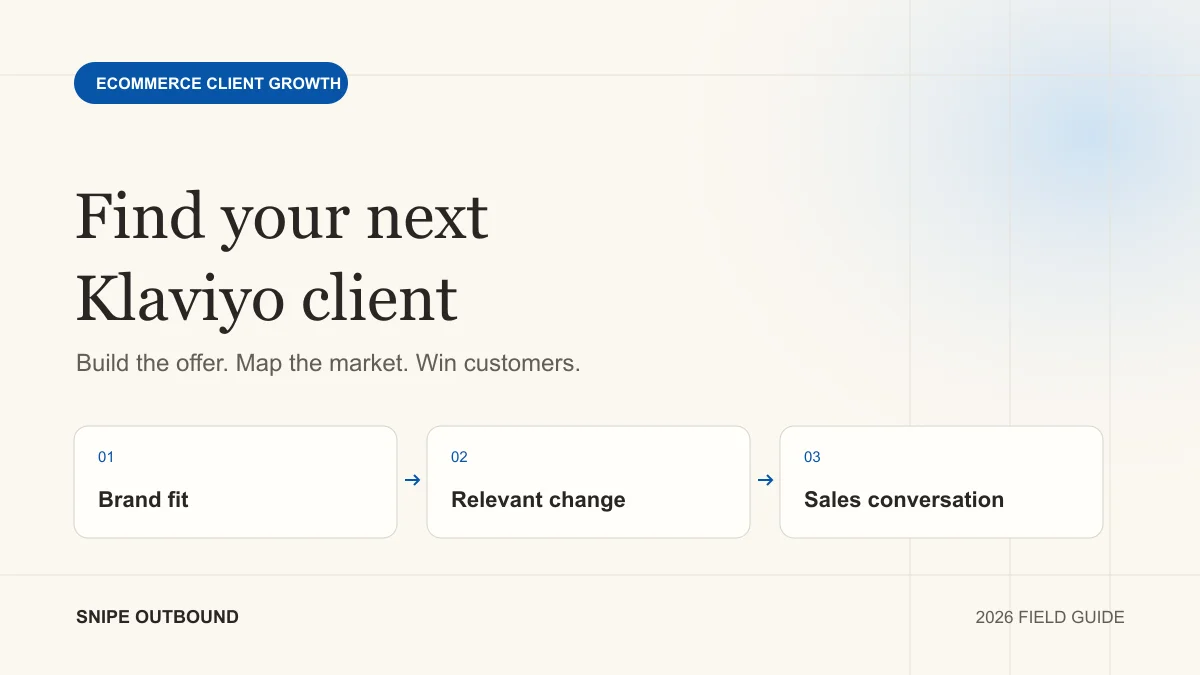
To get clients for a Klaviyo email and SMS agency, choose a brand segment you can serve well, make your offer specific to its customer lifecycle, and combine partner referrals with direct outreach around relevant business changes. Qualify the retention problem with the buyer before recommending work.
Your agency has two different jobs: helping brands retain customers and finding brands that need your agency. Consumer email and SMS campaigns serve the first job. Prospecting for agency clients is a separate B2B sales process with its own account research, outreach and qualification.
1. How can a Klaviyo agency find ecommerce clients beyond referrals?
Start with the work you can deliver and prove. “We manage Klaviyo” describes a tool. A stronger position explains which brands you help, which customer behavior you work on and what an engagement includes.
- Replenishment brands: If you have relevant experience, focus on the journey between the first purchase and the next purchase.
- Subscription brands: Match your experience to onboarding, subscriber communication or retention work the buyer actually needs.
- Brands expanding their catalog: Explore whether lifecycle planning has kept pace with the new products.
Write down category, geography, platform, delivery capacity and exclusions. Remove current clients, partners and open opportunities before prospecting. A detected Klaviyo installation supports platform fit. It does not prove poor performance, a missing flow or a need to replace an agency.
2. What buying signals can you verify before contacting a brand?
Separate account fit from a recent event and from evidence of a problem. Save the source, event date and date you checked it. Then write a question that tests why the event might matter.
| Visible observation | What remains unknown | Useful buyer question |
|---|---|---|
| A new product range appears on the brand's site. | Whether lifecycle campaigns already support it. | How does the new range change your post-purchase journey? |
| A current role mentions retention or lifecycle marketing. | Whether the team wants an agency or is bringing work in-house. | Is the hire taking over delivery, or coordinating outside specialists? |
| The brand announces expansion into another market. | Its launch plan, consent coverage and internal capacity. | Who owns lifecycle planning for that launch? |
| A new ecommerce or marketing leader joins. | That person's priorities, budget and willingness to change providers. | Is retention part of the priorities you are reviewing? |
Funding alone does not prove a retention problem. Neither does a single signup test reveal the complete flow setup. Keep private revenue, attribution, deliverability and customer metrics marked unknown until the buyer supplies them.
Take the question to the person responsible for the work. That might be the founder at a small brand, or a lifecycle, CRM or ecommerce lead at a larger one. Confirm their remit before treating a title as decision-making authority.
3. Should you prioritize partner referrals or cold outreach?
Use referrals for a trusted introduction and direct outreach for deliberate coverage of a defined market. Measure both separately.
Klaviyo lists an agency and solution partner route, a technology partner route, an agency directory and an app marketplace. Explore the appropriate route through Klaviyo's official partner page. A listing or partnership does not guarantee referrals.
- Shopify developers: Discuss when a store build or migration needs a separate lifecycle specialist.
- Paid acquisition agencies: Agree on which customer lifecycle needs sit outside their scope.
- CRO specialists: Define a referral boundary between website conversion work and email or SMS execution.
Give potential partners a clear fit description, relevant proof and a way to introduce a buyer with permission. Avoid asking for their client database. For direct outreach, use the same fit rules but verify the reason to contact each account yourself. Only describe your agency as a Klaviyo partner if that status is current and accurate.
4. What should your agency offer in the first conversation?
Lead with a problem you can help solve, then explain the actual next step. Do not manufacture an audit, revenue estimate or guarantee to make a message sound stronger.
- Name the context: Refer to one verified change relevant to your specialty.
- Test the problem: Ask how the buyer is handling the associated lifecycle work.
- Use matching proof: Share a result you are allowed to publish, with its scope and time window.
- State the real next step: Make clear what the buyer receives and when.
For example, a public product launch can support the question: “How are you adapting the post-purchase journey for the new range?” It cannot support “Your flows are losing revenue.” The first opens a relevant conversation; the second claims access to information you do not have.
See the cold email guide for ecommerce agencies for the broader offer, account and reply workflow.
5. How do you turn an interested reply into a useful sales call?
An interested reply starts qualification. Establish the problem, owner and scope before handing a calendar invitation to the buyer.
- What prompted the review of email or SMS?
- Who owns lifecycle strategy and who handles execution today?
- Does the buyer need strategy, implementation, ongoing management or a combination?
- Which outcome will the team evaluate, and what evidence can it share?
- What internal capacity, approval steps or existing agreement affects timing?
Send relevant proof and a short agenda before the call. Use reminders and handle reschedules. If someone misses the appointment, offer a clear way to rebook without treating silence as continued interest. The agency's seller still owns discovery, the proposal and the close.
6. Which numbers tell you whether client acquisition is working?
Track the journey from target account to new client. Keep the time window and definitions consistent.
- Record the acquisition source, segment and offer for each opportunity.
- Count relevant replies, qualified bookings and held sales calls separately.
- Connect proposals, signed clients and revenue to the same opportunities.
- Review where suitable buyers drop out before changing the message.
If calls happen but proposals do not, inspect qualification and discovery. If appropriate buyers decline the first conversation, inspect the offer and evidence. More sending does not answer either question.
7. What evidence does Snipe have for this kind of acquisition?
Snipe's approach starts with the offer, then a client-owned Market Map, followed by outreach, replies and preparation for held sales calls. Its approved anonymized proof includes 20 sales calls for a Klaviyo and paid ads agency. That result has no published time window or closed-revenue figure, and does not isolate a Klaviyo-only service.
For adjacent ecommerce software proof, Terrific Live's case study reports 100 booked sales calls in 64 sending days. Its 301 interested replies are an all-time total. Those different windows do not establish a conversion rate or predict your results.
Compare service scope in the outbound agency comparison for ecommerce agencies, or review Snipe's outbound service. Your team remains responsible for closing clients.
8. How can you build your first client-fit checklist?
Download the Klaviyo agency client-fit checklist. It contains questions, evidence requirements, unknowns and next steps. It contains no leads. Use it alongside the Ecommerce Market Map worksheet to define and review accounts.
Want 1,000 contacts facing the problem you solve? Snipe delivers your signal-based list on a call with Leon. Relevant events guide the research; a platform installation or funding announcement alone does not establish a need. Get your 1,000-contact list on a call.