
How to Get Clients for Your Shopify Development Agency
A practical client acquisition system for Shopify development agencies, from choosing stores to helping your team win the project.
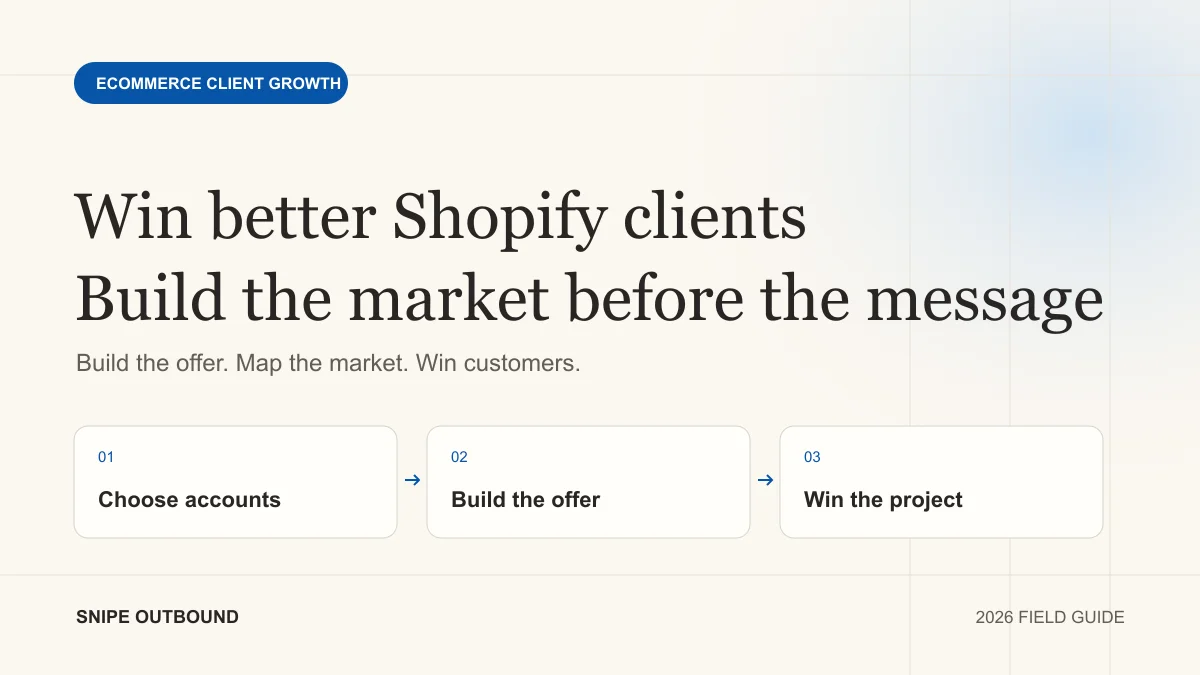
To get clients for a Shopify development agency, choose the stores you can serve, show relevant project proof, and select an acquisition channel that fits how those buyers find help. Referrals, partners, portfolio content, search and targeted outbound serve different jobs. Build the offer and sales process around the route you choose.
This guide is for agencies selling Shopify development, redesigns and ongoing store improvements to ecommerce brands. If you sell an app rather than agency services, use our ecommerce SaaS demand generation guide.
Which client acquisition channel should your Shopify agency choose?
Start with the constraint. If clients recommend you but the introductions arrive unevenly, strengthen that referral process and add a second source. If fitting brands visit your site without enquiring, improve the proof and next step before paying to attract more visitors.
| Channel | Consider it when | A practical first step | What to watch |
|---|---|---|---|
| Client referrals | You have satisfied clients who know other suitable brand owners | Explain which projects fit and give clients a relevant case study they can share | Quality and consistency of introductions, not just how often you ask |
| Agency and technology partners | Complementary providers serve the same brands without doing your work | Agree on the project types each partner can refer and who owns the relationship | Fit, handoff quality, and whether either team can deliver the work |
| Portfolio and educational content | Buyers need evidence of your judgment before starting a project | Explain the problem, decisions, and documented outcome of a relevant project | Qualified enquiries and use of that proof in sales, rather than views alone |
| Search | Buyers already look for help with a specific platform, project, or store problem | Build a focused service page that answers scope, fit, process, and proof questions | Whether search visitors need the projects you want to win |
| Targeted outbound | You can identify fitting brands and a credible reason to approach them | Define a merchant segment and an offer your team can deliver, then assign reply ownership | Account fit, interested replies, held calls, and customers won |
Pick a primary route you can operate consistently and one supporting route. For example, relevant project content can help both a referral introduction and an outbound conversation. A partner program needs active relationships; publishing a partner page alone does not create introductions.
Use the rest of this guide to define the shared foundations: the right brand, a clear offer, useful proof, and a sales owner. If you choose outbound, the cold-email guide for ecommerce agencies covers message structure, offer testing, and the reply desk.
Which Shopify brands should your agency try to win?
Choose accounts your team can serve well and your economics can support. “We work with Shopify stores” leaves too many different buyers in one campaign. A small brand considering its first redesign and an established retailer with a complex store need different conversations.
Write a short account definition before collecting contacts:
- Commercial fit: the brand can support the scope of work you sell.
- Delivery fit: its category, geography and technical requirements match your experience.
- Problem fit: there is a visible issue your service can plausibly address.
- Timing: a launch, new hire or other change gives you a reason to contact it now.
- Exclusions: customers, open opportunities, partners and accounts you should never approach.
Estimated revenue can help you prioritize research. Treat it as an estimate, not proof of a brand's budget or willingness to buy.
What signals give you a real reason to reach out?
A signal is useful when you can connect an observable fact to work your agency does. It is not permission to invent a diagnosis. A store with thin product pages might benefit from stronger merchandising, but that observation alone does not prove lost revenue.
| What you observe | What to investigate | What not to assume |
|---|---|---|
| A new product range | Whether the store supports its new products clearly | The launch is failing |
| Active ads pointing to sparse product pages | Whether the landing experience matches the offer | A specific amount of ad spend is being wasted |
| A new ecommerce or growth hire | Whether the team has a store improvement priority | The new hire controls a redesign budget |
| A dated-looking theme or confusing navigation | Whether a relevant improvement is within your scope | A full rebuild is necessary |
Store the observation, its source and the date you checked it. That gives your salesperson context and keeps an old signal from becoming a misleading opener.
What should a Shopify agency offer a cold prospect?
Lead with the outcome the brand wants. “We build Shopify stores” describes your service. A useful entry offer shows the buyer why a conversation is worth their time.
Before writing email copy, answer four questions:
- Would a busy buyer accept this from someone they have never met?
- Is it clear what the buyer receives and when?
- Does the offer address their actual store or commercial situation?
- Can your team deliver it without creating an expensive unpaid project?
Your first step might draw on an analysis or planning asset your agency already offers. Define its scope and delivery before promoting it. Do not promise a free redesign, a personalized video or a revenue increase because it sounds more clickable.
Snipe documents this work in an Offer Brief for the client to approve. The offer comes before the message. For more detail on that sequence, read cold email for ecommerce agencies.
What should your agency know about each prospective client?
Keep a shared account record across referrals, partners, inbound enquiries and outbound. Record the brand, service fit, source of the opportunity, relevant decision maker, known requirements and next action. Keep customers, open deals and restricted accounts visible so two channels do not create conflicting approaches.
Build a first account brief with the Ecommerce Market Map Builder. Its Shopify development starting point is an editable example; add your own checked sources and project-fit rules.
For outbound, Snipe builds that account universe into a client-owned Market Map. The ecommerce lead database guide covers evidence fields and sample checks; adapt those checks to development projects.
How do you turn interest into a useful sales conversation?
Give every enquiry an owner. Confirm the project fits, answer the buyer's actual question, and agree on the next step. Carry the source, offer and relevant proof into the sales conversation. For detailed outreach and follow-up, use the ecommerce agency cold-email guide.
A pre-call page can bring your proof, common questions and a recorded explanation together. Reminders and no-show follow-up support attendance. The rep still owns discovery, the proposal and closing the project.
How do you compare channels by clients won?
Start with how many suitable projects you want to win, your typical deal size and your observed close rate. Use those inputs to plan activity, then replace assumptions with actual results. Do not turn a planning model into a promise.
| Stage | Question it answers |
|---|---|
| Relevant enquiries and interested replies | Did this channel bring interest from the brands you want? |
| Qualified sales calls booked | Did the interest come from appropriate accounts? |
| Calls held | Did buyers understand and attend the next step? |
| Opportunities and clients won | Did the campaign produce work your agency can deliver? |
Record the source of each opportunity and review results by channel, segment and offer. Include the work required to win and serve the client. If a channel brings interest that never qualifies, revisit its targeting. If qualified calls happen but projects stall, inspect the offer, sales conversation and handoff before increasing activity.
Should you run this yourself or hire an outbound agency?
Run it internally when somebody can own the whole process consistently. Outsourcing is more useful when list building, offer development, sending and reply handling compete with client delivery. Either way, assign one approver and make ownership clear.
Ask a partner to show the account map, offer brief, qualification rules and reporting you would actually receive. Use our guide to outbound agencies for ecommerce agencies to compare scope. If conversion work is your main service, the CRO agency guide addresses that narrower buyer.
Build your next client pipeline around a market you understand. Book a 30-minute Market Map call with Leon to work through target segments, relevant accounts and the offer your agency should lead with.