
Lead Generation for Paid Ads Agencies: Win Larger Ecommerce Clients
Find larger ecommerce clients your team can serve, separate public ad evidence from assumptions and qualify the people and process behind the engagement.
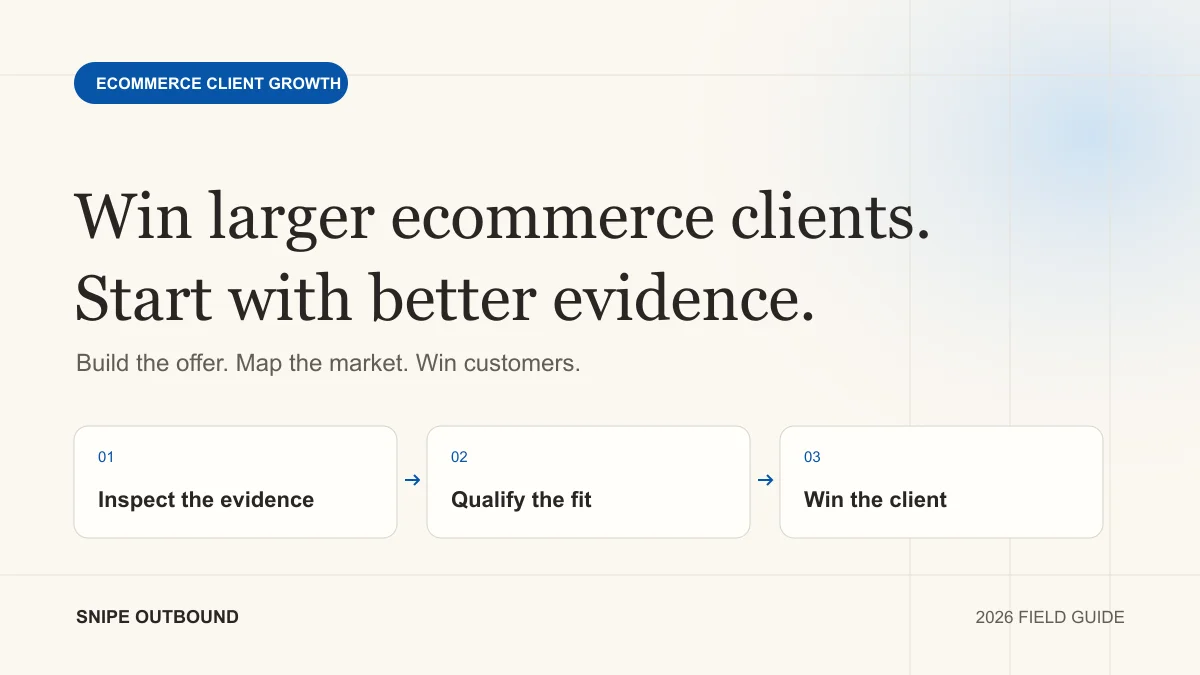
Lead generation for paid ads agencies should find ecommerce brands your team can serve, establish a reason to talk and turn that interest into a qualified sales conversation. An active advertiser is a research starting point. It is not automatically a brand with poor results, spare budget or a plan to change agencies.
This guide is for agencies selling Meta, Google or other paid-media services to ecommerce brands. It covers acquiring clients for your agency, rather than generating consumer leads for those brands.
How can a paid ads agency win larger ecommerce clients?
Move upmarket by showing you can handle the buying and delivery process, not by claiming every larger brand needs better ads. Establish the evaluator, budget approver and implementation owner. Ask about vendor onboarding, existing agency responsibilities and the conditions for adding a specialist.
Define the engagement your team can deliver before building a list. A creative-testing specialist, a shopping-campaign team and a full-service acquisition agency need different accounts.
- Delivery fit: product categories, markets, channels and platforms where you have relevant experience.
- Commercial fit: the client's ability to support the engagement, confirmed through discovery rather than an invented spend estimate.
- Operational fit: someone can approve creative, provide access and coordinate inventory, landing pages and reporting.
- Proof fit: you have permission to share the case or logo, and can explain which results and responsibilities actually belonged to your team.
- Exclusions: existing clients, open opportunities, partners, conflicts and categories your team does not serve.
Write these rules into a client-owned Market Map. Record unknowns instead of forcing every account into a yes or no. The Market Map Builder helps document rules and one sample account. It does not source contacts.
What can ad libraries actually tell you about a prospect?
Use the Meta Ad Library and Google Ads Transparency Center to inspect public ads. Google describes searches by advertiser or website, with region and date filters, in its advertiser transparency documentation. Save the source and filters alongside your observation.
| Observation | Question it can support | What it does not establish |
|---|---|---|
| A visible ad promotes a newly launched product. | Who owns acquisition for the launch? | The product's sales, profitability or campaign budget. |
| Several ads use a similar creative approach. | How is the team planning its next creative test? | Creative fatigue, declining ROAS or a failed agency. |
| An ad leads to a particular product page. | Who coordinates the message and landing-page experience? | The page's conversion rate or revenue loss. |
| Your search returns no matching ads. | Are the advertiser identity, region and date filters correct? | That the brand never advertises or has stopped investing. |
Keep the observation literal. “I saw this product promoted in your ads” is different from “your ads are wasting money.” Public creative alone does not establish account-level spend, returns or profitability.
Which signals create a useful reason to reach out now?
Combine account fit with an event relevant to your service. A product launch may create a launch-planning question. A new growth leader may be reviewing channel responsibilities. Expansion into a market may create localization or creative requirements.
For each event, record its source, event date, observation date and why it could matter. Then record an alternative explanation. A growth hire could strengthen an internal team rather than create demand for an agency. Funding does not prove budget for your work.
Contact the person responsible for that decision. Depending on the brand, that could be a founder, head of growth, ecommerce lead or paid-media owner. Confirm the role instead of sending the same pitch to every executive.
Use the paid ads prospect-evidence worksheet
Download the paid ads agency prospect-evidence worksheet (CSV). It is a blank working sheet, not a database of brands or an assessment of anyone's advertising.
- Record the source. Add the advertiser identity, ad reference, filters and observation date so another person can inspect the same evidence.
- Separate observation from interpretation. Keep the visible creative in one field and your problem hypothesis in another.
- Write the discovery question. Identify what the brand must confirm before you can recommend work.
- Check delivery constraints. Mark access, creative capacity and inventory support as confirmed, unknown or blocked. Add evidence or the question needed to resolve each.
- Choose a next action. Research further, contact the relevant owner, nurture or exclude. Assign a reviewer.
The sheet focuses on paid-media evidence and delivery readiness. Use the broader ecommerce database guide for market coverage and source-quality checks.
What should your agency offer a cold prospect?
Describe an outcome your team can support, relevant proof and a first step you can deliver. “We run Meta ads” leaves the buyer to work out why that matters to this account now.
For example, a product-launch event might inform a conversation about a defined creative-testing plan. This is an illustrative offer pattern, not a claim that a free plan, audit or performance guarantee is available. Your agency must approve the scope, delivery timing and evidence before using it.
Write the offer before the email. Keep claims tied to evidence and test offers within a consistent segment. Our cold email guide for ecommerce agencies covers message structure, testing and reply handling.
What qualifies a paid ads agency sales call?
- The brand fits your delivery and exclusion rules.
- The participant owns the problem or can involve its owner.
- The buyer understands the offered first step and has expressed interest.
- Unknown budget, access or timing remains labeled unknown.
- Your rep knows the observed event, the buyer's reply and what was promised.
- Commercial approval, technical access and vendor-onboarding requirements have owners, even when different people handle them.
Discovery should establish access to measurement, creative production, approval ownership and operational constraints. Ask for authorized information through an agreed process. A public ad is not a substitute for that conversation.
Judge acquisition by interested replies, calls held, accepted opportunities and clients won. Review rejection reasons by segment and offer. More bookings are not useful if your team repeatedly finds the brands cannot support the engagement.
What evidence and support can Snipe provide?
Snipe's current process starts with a client-approved Offer Brief and Market Map, then outreach, the reply desk and preparation for the sales call. The client keeps the map and operating assets. The client's reps own discovery, proposals and closing.
The approved anonymized result for a Klaviyo and paid ads agency is 20 sales calls. No reporting window or closed-client total is specified. This is one agency with both services, not separate results for each service or a forecast for your agency.
For named adjacent evidence, Terrific Live sells live-shopping software to ecommerce brands. Its case separates 100 sales calls booked in 64 sending days from 301 interested replies all time. That software engagement is not a paid ads agency case study.
When evaluating support, ask who answers replies, prepares buyers, handles no-shows and reports outcomes. Snipe manages those stages under agreed rules, with LinkedIn as a second lane where relevant. The ecommerce outbound agency comparison helps structure that choice.
Build your agency's next client pipeline
Bring your service, strongest proof and account exclusions. Get 1,000 contacts facing the problem you solve. We will walk through your signal-based list on a call.