
Lead Generation for 3PL Companies: Find Better-Fit Ecommerce Clients
A practical outbound framework for physical fulfillment providers, from choosing shipper accounts to qualifying the conversation for sales and operations.
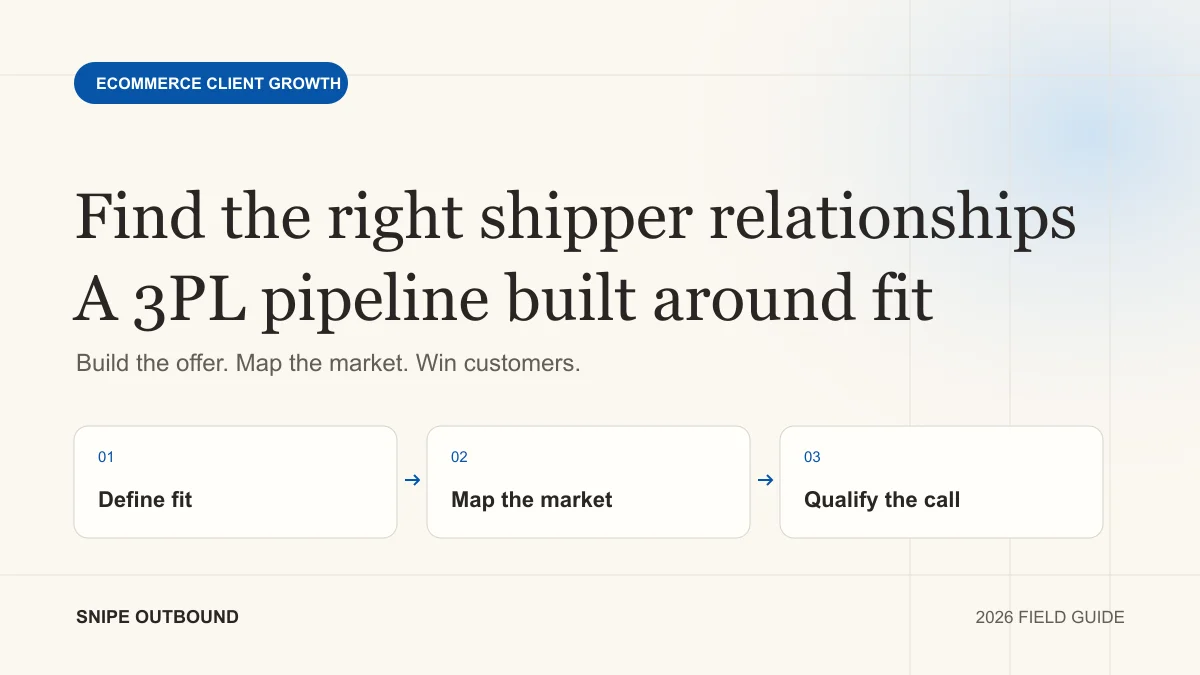
Lead generation for a 3PL starts with operational fit: find ecommerce brands whose products, shipping requirements and growth plans match the fulfillment service you can deliver. Then reach the appropriate decision maker with a specific reason to talk and qualify the opportunity before asking your operations team to scope it.
This guide concerns physical third-party logistics and fulfillment providers selling to ecommerce brands. It does not describe selling logistics software. The goal is new shipper relationships that make commercial and operational sense, not simply more names in a sales database.
What makes an ecommerce brand a qualified 3PL prospect?
A brand can look attractive on paper and still be wrong for your operation. Start by writing down what you can serve, what you want more of and what you must exclude.
| Fit area | What your team needs to establish |
|---|---|
| Product | Category, handling needs and any requirements outside your capabilities |
| Geography | Where inventory must be held and orders need to reach customers |
| Order profile | Volume, variability, order complexity and seasonal expectations |
| Services | Which fulfillment, returns or related operations the brand actually needs |
| Commercial fit | Whether the likely relationship fits your minimums and delivery economics |
| Timing | A credible reason to evaluate a provider and a workable decision window |
Some fields belong in initial research. Others require a conversation. Mark unknowns clearly. A store's estimated revenue does not establish its order count, inventory profile or readiness to switch fulfillment partners.
Which buying signals are worth investigating?
Look for a business change that could make fulfillment relevant. A signal is a reason to research, not proof of dissatisfaction with an existing provider.
- A new market or product launch: investigate whether the operating requirements are changing.
- A relevant operations hire: establish the person's remit before assuming they own vendor selection.
- Recent funding or expansion: check what the company actually plans to do with it.
- Growth in visible selling activity: use it to prioritize research, then confirm volume directly.
- A stated operational priority: connect your approach to what the brand has publicly said it wants to improve.
Do not open with “your fulfillment is broken” because a brand has grown. That claims knowledge you do not have. A useful message starts with the observable change and asks whether the related requirement is relevant.
How should a 3PL build its target account database?
Build the market around your service constraints rather than buying an undifferentiated list of stores. Group accounts into segments that would receive genuinely different offers and require different qualification questions.
For each account, retain:
- The brand, website, product category and research source.
- Verified platform and geographic information where available.
- The fit assessment, evidence and unresolved questions.
- The observed buying signal and research date.
- The likely decision maker and verified business role.
- Customer, partner, open-deal and other exclusion status.
- Prior contact history, replies and the next action.
Keep account fit separate from contact availability. Finding an email address does not make a company suitable. Snipe's Market Map approach uses written inclusion and exclusion rules, verifies and segments accounts, and leaves the database with the client. The ecommerce database guide covers the research structure; a 3PL should use fulfillment-specific qualification fields.
Who should your outreach reach at an ecommerce brand?
Choose the person responsible for the decision, not a title that looks senior. At one brand, a founder may still own fulfillment. At another, an operations or supply-chain leader may evaluate providers with finance and ecommerce colleagues.
Use title research as a starting point and confirm responsibility in the conversation. A good reply process can route interest without pressuring someone who does not own the issue. Record the person's role in the decision and who else needs to participate.
That context is useful to both sales and operations. It prevents a salesperson from entering a call knowing only that someone accepted an invitation.
What should the first outbound offer be?
Make the first step about whether your operation can address the brand's situation. Define what your team needs to learn and what the buyer receives before promoting the offer.
For a provider that already offers a scoped fit review, the message can explain that review and the inputs it requires. If your team does not provide it, do not invent a free assessment, savings report or implementation plan in the email.
- Connect the offer to an observed business change.
- State the scope in words an operator would understand.
- Use relevant proof you can substantiate.
- Give the buyer one clear next step.
- Leave rates, savings and delivery commitments to a properly scoped conversation.
Snipe builds an approved Offer Brief before outreach. The offer-first outreach guide explains the method, although its agency examples should not be copied into a fulfillment campaign without changing the buyer problem and deliverable.
What should happen between an interested reply and a sales call?
Set written qualification rules before launch. Your reply desk should know which requirements it can confirm, what it must ask and when to involve someone with operational knowledge.
- Establish relevance: confirm the brand is considering a requirement you can serve.
- Check major exclusions: identify a product, geography or service mismatch early.
- Clarify timing: understand the evaluation window without inventing urgency.
- Bring the right people: agree who needs to attend the next conversation.
- Prepare the handoff: give the rep the account context, reply history, offer and open questions.
A pre-call page can explain the service and answer common questions. Relevant proof and reminders help the buyer arrive prepared. If they miss the call, follow up and offer a way to reschedule. Your team remains responsible for operational scoping, commercial commitments and closing the relationship.
How do you measure lead quality for a fulfillment campaign?
Follow the campaign beyond booked calls. A full calendar is not the result if the opportunities require work you cannot deliver.
- Track interested replies by account segment and offer.
- Record why a booking meets or misses the qualification rules.
- Separate booked calls from calls actually held.
- Track operationally suitable opportunities, proposals and new clients.
- Review lost opportunities for recurring fit or handoff problems.
Use your actual deal economics and close rate to plan pipeline needs. Review assumptions as results arrive. This produces a more useful decision than choosing a provider on a promised meeting count alone.
What should you ask a 3PL lead generation partner?
Ask who owns the account research, offer, replies, qualification and sales handoff. Request an example of the reporting and account map, and establish what your team keeps when the engagement ends.
Snipe serves companies selling to ecommerce brands, including fulfillment providers. The client approves whom to target, what to say and what qualifies. Snipe runs the agreed outreach system, with visible replies and bookings, Friday reporting and strategy with Leon. Compare scope in our ecommerce outbound agency guide, while requiring evidence relevant to your own fulfillment service.
Book a 30-minute Market Map call with Leon to define the ecommerce accounts your operation can serve and the signals that make them worth approaching.