
The Easiest Way to Do AEO for B2B SaaS in 2026
A practical AEO workflow for B2B SaaS teams, based on what we did at Snipe. Follow the steps and adapt the included prompt to your software business.
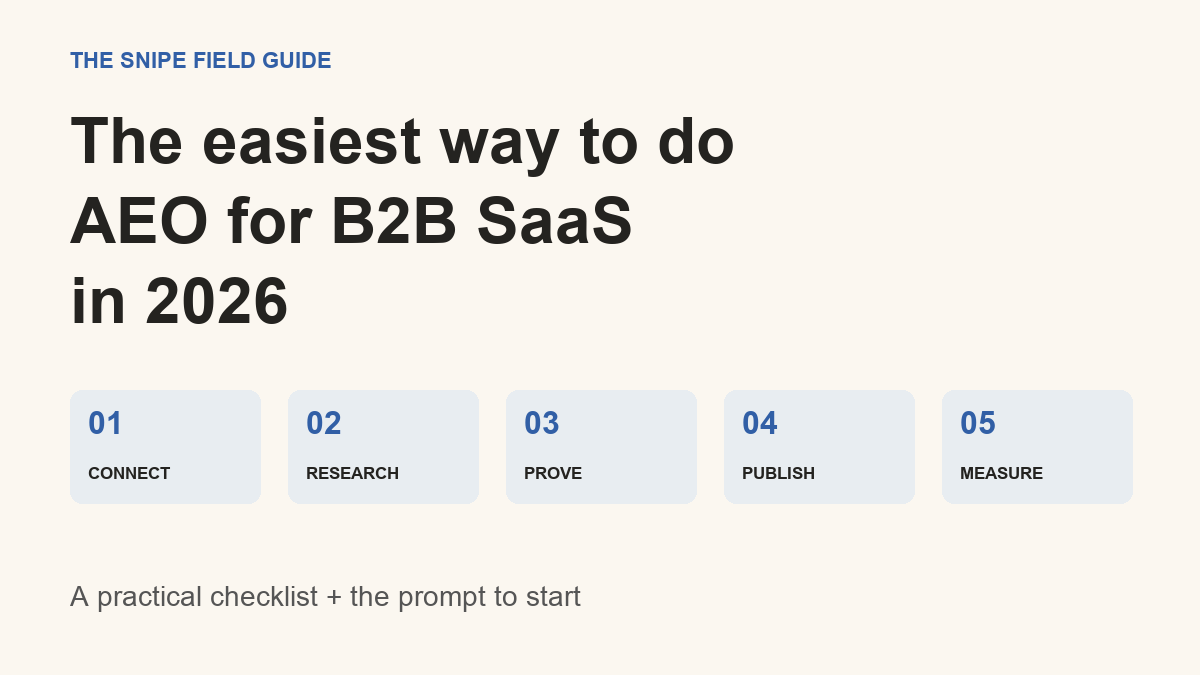
Give Codex your website, search data, buyer definition, and real proof. Ask it to diagnose gaps, improve the pages that matter, and measure qualified calls. Work through the checklist below, then copy the prompt.
What I did at Snipe
- I started with no AEO experience and used Codex to help improve Snipe’s website.
- I now average 5–7 calls a week that I attribute to this work. That is my reported experience, not a controlled attribution study or a promise of what another business will get.
- My target: mid-market and enterprise B2B software companies looking for lead generation, demo booking, cold email, and go-to-market support.
- The workflow covered search research, existing-page improvements, client evidence, internal links, technical checks, and backlink opportunities.
1. Give Codex the right access and context
- Connect your website repository or CMS using supported access. Tell it how changes reach the live site.
- Connect Google Search Console and your analytics, or upload exports if a connector is unavailable.
- Add a keyword tool such as Semrush if you have it. Use the reports available on your plan.
- Provide your actual offer, ideal customer, client roster, approved results, and booking destination.
- Keep credentials in the appropriate connection or secret store. Never put them in website files or public prompts.
2. Define who you want to attract
- Replace “get me more traffic” with a buyer, problem, and conversion goal.
- Our example: “Help Snipe attract mid-market software companies that need qualified demos through managed cold email.”
- Specify the markets where you have experience, the buyer roles, and who is a poor fit.
- Give it exclusions. We explicitly told Codex not to describe Snipe as a pay-per-call agency.
- Define success as qualified conversations and sales opportunities, with impressions and rankings as supporting signals.
3. Audit what you already have
- Review queries and landing pages over a consistent date range. Separate branded searches from relevant nonbranded searches.
- Find pages receiving relevant impressions but few clicks. Check whether their title and opening answer match the buyer’s need.
- Check indexability, canonical URLs, broken links, sitemap coverage, mobile layout, and the booking path.
- Improve an existing page when it already serves the intent. Avoid publishing a near-duplicate just to target another phrasing.
- At Snipe, irrelevant and branded queries complicated the traffic story. A rising click total did not automatically mean more software buyers.
4. Turn buyer questions into a useful topic map
- Start with phrases your buyers actually use: “fintech lead generation agency,” “HR tech demo generation agency,” and “best B2B software lead generation agency.”
- Group follow-up questions around fit, services, evidence, pricing, qualification, and alternatives.
- Use clear headings such as “Which software buyers does this agency reach?” and “What counts as a qualified demo?”
- Answer closely related questions together when that creates a better page.
- Inspect visible AI search sources as research clues. They are not a complete record of what every model will search next.
Google’s current guidance describes query fan-out as searching related questions. It also says SEO fundamentals still apply and warns against creating pages for every query variation primarily to manipulate visibility. Use a topic map to serve buyers, not to mass-produce pages.
5. Add proof that belongs to your business
- Use real client names, original logos, and accurate market descriptions.
- For us: Puzzle means accounting and fintech software; MyLearningHub means learning software; MaestroX means title-insurance technology.
- We published 11 client profiles and a directory, connecting the companies to their markets and available evidence.
- Separate a client relationship from a results case study. A logo does not establish a meeting count, revenue result, or endorsement of every service.
- Keep measurement windows visible. Our Terrific Live case study reports 100 demos booked in 64 days of sending; 301 interested replies is an all-time figure.
- Use your own research, screenshots, methodology, and actual experience where available. Never borrow a client’s results with its customers and label them your own.
6. Publish a page people can actually use
- Give the direct answer near the top, then show the steps, evidence, and examples.
- Use bullets when they make instructions easier to follow. They are a reading preference, not a special AI ranking trick.
- Include an author, a meaningful review date, sources, and links to related pages.
- Give the page a descriptive title, a canonical URL, and appropriate metadata.
- Check the cover, text contrast, links, and mobile layout before publishing.
- Add the page to the relevant hub and sitemap. Submit or inspect it through the search tools you use; submission does not guarantee indexing.
Google says there is no special schema or AI text file required for its generative search features. Useful content, technical accessibility, and a good visitor experience remain the foundation. Read the official guidance.
7. Build relevant mentions and backlinks
- Ask Codex to find accurate industry directories, existing partner mentions, and articles where your evidence would help the reader.
- Start with existing relationships. If someone cites your research but links only to your homepage, draft a request for a link to the actual research page.
- Prepare consistent company descriptions: what you do, who you help, and the services you actually provide.
- Review directory quality and audience fit before spending money or submitting a listing.
- Have Codex prepare outreach and submission drafts. Approve the recipients and message before anything is sent on your behalf.
- Avoid fake reviews, invented awards, paid ranking promises, and bulk irrelevant placements.
8. Make the next step obvious
- Connect the guide to a relevant service page, client example, or booking action.
- Tell visitors who the service fits and what the conversation will cover.
- Test the booking form on mobile and desktop.
- Track the landing page and CTA source so you can connect content to bookings.
- Keep the service accurate. This article shares our own acquisition workflow; Snipe’s core client service is managed cold email and appointment setting.
9. Measure calls, then improve the weak point
- Track relevant search visibility, visits, bookings, held calls, qualified calls, and opportunities separately.
- Ask booked prospects how they found you. Compare their answer with available analytics and CRM history.
- Distinguish an AI referral, ordinary organic search, and someone who searched your name after receiving a cold email.
- Log each change and its date. Compare equivalent periods and avoid attributing every increase to the latest edit.
- Improve the bottleneck: relevance, trust, clicks, booking conversion, or qualification. More articles cannot fix every problem.
Copy this Codex prompt
Replace the brackets, connect the available tools, and use this to start:
Act as an SEO and AEO specialist for [company and website].

Goal: attract [buyer roles] at [company types, size, and verticals] who need [actual service], and increase qualified [calls/demos].

Use my website repository or CMS, Google Search Console, analytics, and any connected keyword tools. First report which sources you can actually access and their date ranges. Do not invent missing data.

Read the existing site and approved company facts. Identify the biggest gaps in buyer intent, technical SEO, useful content, client proof, internal links, authority, and conversion.

Prioritize existing pages before creating overlapping articles. Research primary sources. Map buyer questions and plausible follow-up questions without claiming you know every AI query.

Use real clients, original logos, and approved results. Keep client relationships separate from measured outcomes. Do not invent testimonials, rankings, services, or guarantees.

Create concise step-by-step content with practical examples. Add accurate metadata, appropriate structured data, relevant internal links, and sitemap entries. Preserve the existing design and booking flow.

Prepare relevant directory submissions and backlink outreach. Do not send messages, purchase placements, create accounts, or accept terms without my approval.

Implement reversible website changes within the access and publishing scope I have authorized. Test links, mobile layout, indexability, and conversion tracking. Verify published changes on the live site.

Report what changed, what evidence supports it, what remains blocked, and which bottleneck matters next. Measure qualified calls and opportunities, not only page count or impressions.
Download the prompt as a text file
Your first pass
- Choose one buyer segment.
- Review the existing page that best serves that buyer.
- Add a direct answer and genuine proof.
- Make the next step clear.
- Publish, verify, and track what happens.
Explore Snipe’s enterprise outbound service or discuss your target market and demo-booking needs.