People Data Labs Alternatives: 6 Routes, Chosen by What You Need to Replace
A profile API, a sales database, a waterfall orchestrator, and an email finder are not interchangeable. Start with the job, then shortlist the vendor.
If your product depends on People Data Labs' profile matching, schema, or persistent identifiers, compare another data API first. If your actual need is rep prospecting, orchestration, or verified work-email coverage, compare the tools built for that narrower job. Do not score all four categories in one feature table.
People Data Labs documents its Person Enrichment API as a one-to-one match against its person dataset, returning fields from its person schema when a match is found. That is a different procurement decision from buying a prospecting UI or finding one deliverable work email.
This guide takes no affiliate fees. It separates six plausible replacement routes by use case, cites the vendors' own product documentation for category claims, and labels Snipe's email-provider study separately so a narrow benchmark is not presented as proof about an entire platform.
First decide what “replace People Data Labs” means
Your application needs matching logic, stable fields, bulk access, response semantics, and a migration path for stored identifiers.
Reps need to search accounts and contacts, inspect records, export or sync them, and work inside a governed sales process.
You already have base records and need rules that call several providers in sequence, preserve provenance, and control spend.
You already know the company or buyer and need a valid work email. This is one output field, not a replacement for a person-data schema.
People Data Labs alternatives at a glance
| Route | Use it when the main job is | Important boundary |
|---|---|---|
| Coresignal | Employee, company, or jobs data through APIs and datasets | Closest route here to an API/data-product evaluation; still requires schema and rights review |
| Apollo | A searchable B2B contact database plus sales workflow | Evaluate the UI, CRM behavior, export terms, and API separately from raw-data needs |
| ZoomInfo | Enterprise sales intelligence and account/contact workflow | A sales-intelligence purchase is not automatically a drop-in data-pipeline migration |
| Cognism | European growth and phone-led prospecting | Test the exact countries, roles, and fields your team will use |
| Clay | Calling multiple enrichment providers in a controlled waterfall | It orchestrates providers; it does not make every underlying source equivalent |
| QuickEnrich → MoltSets → BounceBan | Verified work-email coverage after the account or buyer is already known | Snipe tested this email layer; it does not replace PDL's broader profile schema |
The six replacement routes
1. Coresignal for an API-first data product
Coresignal's current API documentation lists company, employee, and jobs APIs with search, collect, bulk, enrichment, and—in some products—webhook paths. It belongs on the first shortlist when the requirement is programmatic profile or company data rather than a rep-facing database.
Before treating it as a substitute, map every PDL input, output field, identifier, null behavior, match threshold, rate limit, and deletion obligation to the candidate API. A broad record count is not schema parity.
2. Apollo for a self-serve prospecting database and workflow
Apollo positions its product around contact and account search, filters, CRM export, enrichment, and engagement. That can replace the daily workflow of a sales team that used PDL-derived data indirectly, even when it is not a like-for-like replacement for a data product built on PDL's schema.
Run the evaluation in the CRM and sequence workflow the team will actually use. Measure current-company accuracy, usable-contact yield, deduplication behavior, field overwrite rules, and cost per accepted record—not the size printed on a landing page.
3. ZoomInfo for an enterprise sales-intelligence workflow
ZoomInfo's sales product is a route to investigate when procurement, account intelligence, rep workflow, and enterprise administration are central to the decision. Confirm the exact modules, data fields, export rights, CRM sync behavior, support model, and contract terms in the proposal you receive.
If the present system calls PDL inside a product, a rep-facing ZoomInfo deployment and an API migration are separate projects. Score them separately.
4. Cognism for European and phone-led prospecting
Cognism currently emphasizes European coverage, compliance controls, and phone-verified mobile data. It is a relevant route when the buying question is “can our team reach the right people in these named European markets?” rather than “can we reproduce this PDL response object?”
Build the sample by country, seniority, function, and phone-versus-email need. A blended global match rate can hide a failed priority market.
5. Clay for provider orchestration
Clay's waterfall documentation describes sequentially calling multiple providers and stopping after a valid result. That makes Clay an orchestration route for RevOps teams that want provider order, conditions, provenance, and reusable workflows.
Clay is not evidence that any one provider is accurate for your market. Keep provider-level outputs visible during the trial so you can audit which source won, what it cost, and whether the returned company and person are correct.
6. A verified-email waterfall for the narrow email layer
If the real job is “we already know the account and buyer; find a deliverable work email,” a focused waterfall can cost less and be easier to govern than replacing an entire data platform. Snipe's tested core sequence is QuickEnrich → MoltSets → BounceBan. It is intentionally presented as an email-layer option, not a direct PDL replacement.
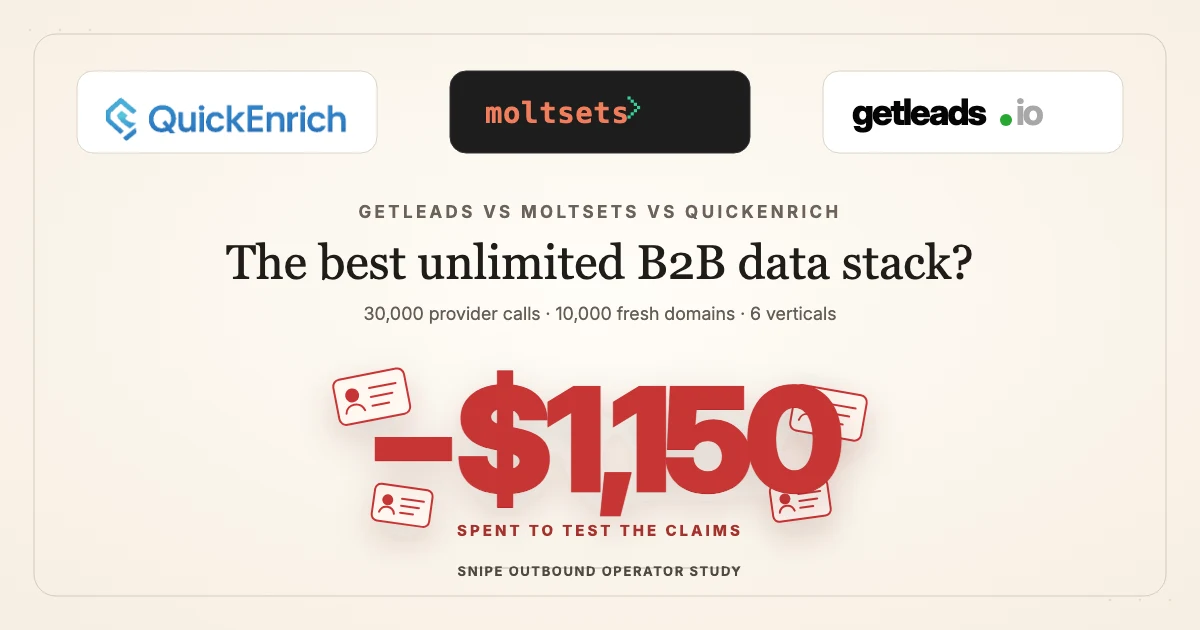
We spent $1,150 across 30,000 provider calls on 10,000 fresh domains in six verticals. Across that sample, all three email providers combined reached 29% coverage. The provider returning the most emails also carried the most wrong-company risk, and the fastest provider was 21× faster than the slowest without winning overall. Read the full unlimited B2B data benchmark for the locked methodology, pricing, and waterfall decisions.

A procurement test that survives the sales demo
Freeze one holdout set before any vendor runs it. Include your priority segments, hard geographies, seniority bands, sparse records, known negatives, and records with a trusted current answer. Give every candidate the same inputs and score the same outputs.
| Decision metric | What to record |
|---|---|
| Coverage | Percentage of rows with the required field—not merely any returned record |
| Correctness | Current company, current role, correct person, and field-level accuracy against trusted truth |
| Usable yield | Records that pass your match, consent, geography, and verification rules |
| Failure behavior | Nulls, ambiguous matches, stale roles, wrong-company records, retries, and response codes |
| Operations | p50/p95 latency, bulk behavior, rate limits, provenance, monitoring, and support escalation |
| Governance | Permitted use, retention, deletion, suppression, regional processing, and audit evidence |
| Economics | Total cost per accepted record, including orchestration, verification, engineering, and manual review |
Do not copy Snipe's 29% email-coverage result into your business case as a universal market rate. The right sample is your own target market, with your own required fields and acceptance rules.
When staying with People Data Labs may be the lower-risk decision
Staying is reasonable when the current schema, identifiers, matching behavior, and operating history already meet the requirement—and the proposed replacement has not shown a material gain on the same holdout. Price alone does not prove lower total cost.
For a data-product migration, run the candidate in parallel, retain the old identifier and response for comparison, quantify downstream breakage, and define rollback before changing production reads. For a sales-workflow change, pilot one team or segment before rewriting CRM-wide rules.
The next decision after provider selection
For provider pricing and email waterfalls, use the 30,000-call data-stack study. For account and contact controls, use the B2B prospect-list operating guide. Before increasing volume, run the enterprise outbound readiness checklist.
If the actual constraint is operating the outbound system
A data vendor does not define the ICP, approve exclusions, write the message, manage dedicated sending infrastructure, handle replies, qualify prospects, or book the calendar. If those operating steps—not API selection—are the unresolved constraint, review Snipe's enterprise outbound scope. A 20-minute diagnostic can determine whether the scope fits; it is not required to use the evaluation framework above.