Cold Email vs LinkedIn for B2B SaaS
Compare cold email and LinkedIn outreach by reach, control, professional context, platform risk, and operating fit—without relying on a universal channel benchmark.
Email offers broader researched reach through dedicated infrastructure; LinkedIn offers visible professional context inside a platform-governed network. Choose based on target-market size, buyer behavior, deliverability, account risk, qualification quality, and who will operate each channel.
Cold Email vs LinkedIn: The Short Answer for B2B SaaS
If you sell B2B SaaS and you are deciding where to put your outbound budget, the cold email vs LinkedIn debate usually gets framed as a winner-take-all fight. It is not. They are two different tools that do two different jobs. Cold email can reach a broader researched market through dedicated sending infrastructure, but it is constrained by data quality, deliverability, mailbox-provider rules, law, and recipient tolerance. LinkedIn adds visible professional context, but member accounts, invitations, and InMail operate within LinkedIn's limits and policies.
For most B2B SaaS teams chasing a steady flow of qualified demos, email is what scales and LinkedIn is what warms. The best programs do not pick one. They lead with email for reach and use LinkedIn to make the email land softer. Below is the honest math on reach, cost, reply rates, and when each channel earns its place, plus a comparison table you can use to decide today.
Reach: Where Cold Email Wins Outright
Reach is the cleanest difference between the two channels, and it is not close.
- Cold email reaches beyond a social graph. A verified business address does not require a connection request, but responsible reach is still limited by the legitimate target market, consent and legal requirements where applicable, deliverability, provider policies, and suppression rules.
- LinkedIn is gated by connections and platform limits. LinkedIn says all members are subject to invitation limits and may be restricted based on invitation volume, ignored or pending invitations, spam reports, or suspected automation. It does not publish one universal safe weekly number. InMail can reach people outside your network, but Sales Navigator credits are finite and messages must be sent individually.
LinkedIn's current documentation explains its invitation restrictions, Sales Navigator InMail credits, and individual-send requirement. Verify current rules before building a channel plan.
For a SaaS company that needs to put a specific, narrow message in front of a few thousand qualified buyers this quarter, email reaches the whole list in days. LinkedIn would take weeks of connection requests just to open the door, and that is before anyone replies. If your total addressable market is small and senior, the gap narrows. If you are running real volume, email wins reach every time.
Cost and Scale: The Math That Decides Most Programs
This is where the cold email vs LinkedIn decision usually gets made, because it comes down to how many qualified conversations you can start per dollar and per hour.
Cold email scales horizontally
Email can scale across dedicated sending domains and inboxes while daily volume stays conservative, but infrastructure does not create an unlimited market or remove the human work of research and reply handling. The hard constraints are legitimate audience size, targeting quality, list accuracy, deliverability, law, provider rules, and recipient response. A weak list burns domains and reputation, which is why list quality matters more than raw volume. If you want to pressure-test yours, run it through our cold email list grader before you send a single message.
LinkedIn scales vertically, and slowly
LinkedIn scale is bounded by the platform. More seats do not authorize prohibited automation. LinkedIn says third-party bots, crawlers, browser extensions, or other software that scrapes or automates activity on its website are not permitted; review its prohibited software policy. That makes LinkedIn better suited to selective, human-led touches than a promise of unlimited activity.
The practical takeaway: if your goal is a repeatable flow of demos every month, email gives you a dial you can turn. LinkedIn gives you a lever you can pull a limited number of times.
Reply Rates: Compare Like With Like
A LinkedIn message can carry visible context—a real profile, role, activity, and mutual connections—that an unfamiliar email address does not. Email can reach a broader researched audience without first earning a connection. Neither fact produces a universal reply-rate winner.
Channel benchmarks are easy to misuse because vendors count different denominators and outcomes. A connection acceptance is not a reply. A reply is not necessarily positive. A positive reply is not necessarily qualified. Compare each channel using the same definitions:
- Delivered first touches: messages that actually reached the intended recipient;
- Positive conversations: replies that indicate a relevant problem, interest, or useful referral;
- Qualified meetings: conversations that meet the account, role, use-case, and timing rubric;
- Held meetings and opportunities: downstream outcomes the sales team can verify.
Use your own funnel and a controlled test before trusting a cross-channel benchmark. Our guide on how many cold emails it takes to book a meeting shows how to connect email activity to meetings without treating an industry average as a promise.
Deliverability and Trust: The Hidden Variables
Two factors sit underneath every reply rate and decide whether either channel works at all.
Deliverability is email's make-or-break. A great message that lands in spam gets zero replies. Cold email only works on a foundation of authenticated, warmed domains, clean lists, and conservative volume. This is also why serious senders never use the client's primary domain for cold outreach. One bad campaign can poison the domain your whole company emails from. Dedicated sending domains keep that risk contained. If you are not sure where your setup stands, our spam checker and our full cold email deliverability guide will show you what to fix first.
Visible context is LinkedIn's built-in advantage. A complete, accurate profile lets a prospect inspect the sender's role, company, activity, and mutual connections. That can reduce uncertainty, but the profile still must support a relevant message. If your team's profiles are incomplete, fix them before treating LinkedIn as a serious outbound channel.
Cold Email vs LinkedIn: Side by Side
| Factor | Cold Email | LinkedIn Outreach |
|---|---|---|
| Reach | Broad, but bounded by fit, data, deliverability, law, and provider rules | Bounded by network access, invitations, InMail, and platform policy |
| Scale | Horizontal, add domains and inboxes | Vertical, capped by the platform |
| Cost per touch | Very low at volume | Higher, especially with InMail and Sales Navigator |
| Reply rate per message | Lower per message, wins on volume | Higher per message, limited by volume |
| Trust at first touch | Must be earned by copy and proof | Built in through your profile |
| Main risk | Deliverability and domain reputation | Account restrictions and slow ramp |
| Best at | Predictable, high-volume pipeline | High-trust touches and warming |
| Personalization ceiling | High with research and signals | High through visible context |
When to Use Each, and When to Run Both
You do not have to choose forever. You choose based on your motion, your market, and your stage.
Lead with cold email when
- You need predictable volume and a pipeline you can forecast.
- Your total addressable market is large enough to feed real send volume.
- You want the lowest cost per qualified conversation.
- You are testing messaging fast and need a big enough sample to trust the read.
Lean on LinkedIn when
- Your market is small, senior, and allergic to anything that smells templated.
- You are selling on relationships, mutual connections, or thought leadership.
- You want to warm a named account list before or alongside email.
- Your reps already have credible, active profiles worth showing off.
Run both when you want the best results
A coordinated multichannel motion can make one touch easier to recognize after another, but adding a channel does not automatically improve results. A simple sequence to test looks like this:
- Send a researched, per-prospect cold email that earns attention on its own.
- A day or two later, send a light LinkedIn connection request with no pitch.
- Let the prospect connect your name to a real face and a real company.
- Follow up by email, now recognized rather than cold.
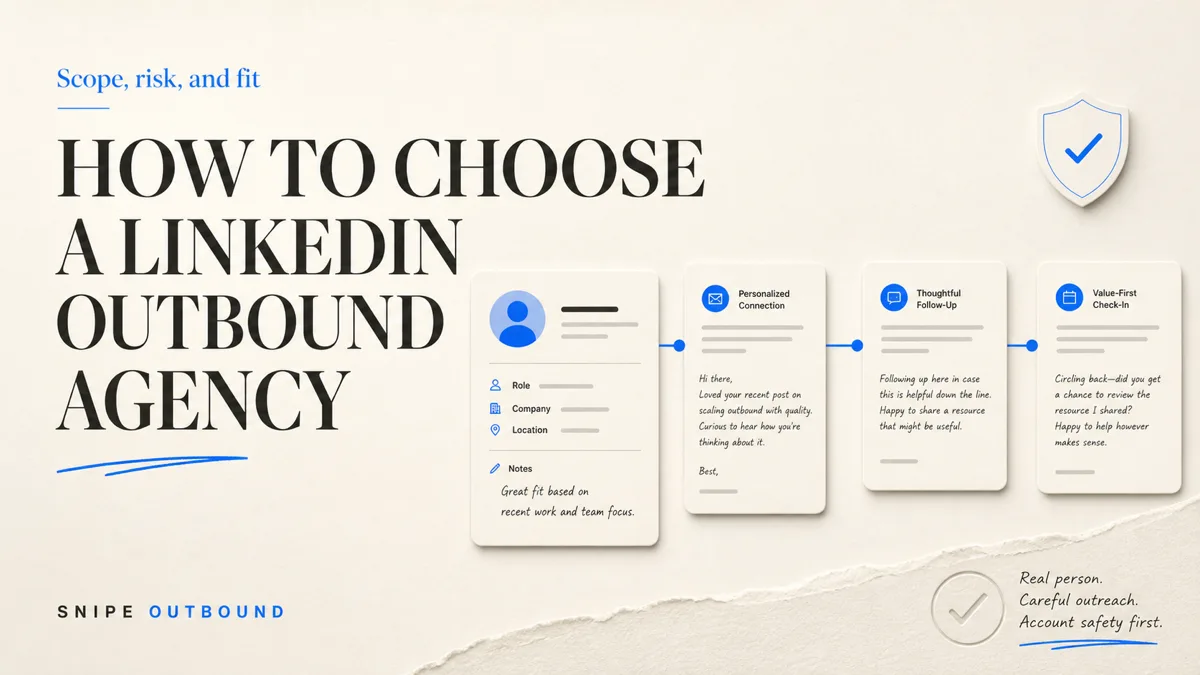
The point is not to blast the same message on two channels. It is to use LinkedIn to remove the suspicion that holds email replies down, and to use email to carry the volume LinkedIn cannot. Email scales the program. LinkedIn warms it. To make either one work, your targeting and copy have to be sharp, which is why we build campaigns on a tightly researched prospect list and copy written per prospect rather than one template sprayed at everyone.
What This Looks Like Done Right
The reason most teams stall is not that they picked the wrong channel. It is that they ran the right channel badly. Cold email on a cold domain lands in spam. LinkedIn from an empty profile gets ignored. A generic template on either channel gets deleted in both places.
Done right, the system looks like this. Targeting is built on real buying signals, not just a job title filter. Email goes out on dedicated, warmed domains so your primary domain stays clean. Every message is researched to the individual prospect rather than mail-merged. And follow-up is consistent and fast, because most replies and most booked demos come from the second, third, and fourth touch, not the first. You can audit one piece of that right now with our cold email grader, which scores a real message against what actually gets replies.
Book More Demos Without Guessing the Channel
Cold email vs LinkedIn is the wrong fight for most B2B SaaS teams. Email can carry broader researched reach; LinkedIn can add selective professional context. Let target-market size, buyer behavior, platform risk, and the quality of resulting conversations determine the mix. If you are evaluating a specialist, use our LinkedIn outbound agency buyer's guide. Snipe itself does not sell LinkedIn automation, profile management, or LinkedIn messaging. It runs email-led outbound: approved targeting, researched copy, dedicated infrastructure, reply handling, qualification, and booking. Book a call if that is the execution gap you need to solve.