
Best Dealership Contact Data: Our DealerData Review
DealerData achieved 98% accuracy in Snipe's reported 200,000-lead test. See our review, dealership-data buying criteria and the scope of the result.
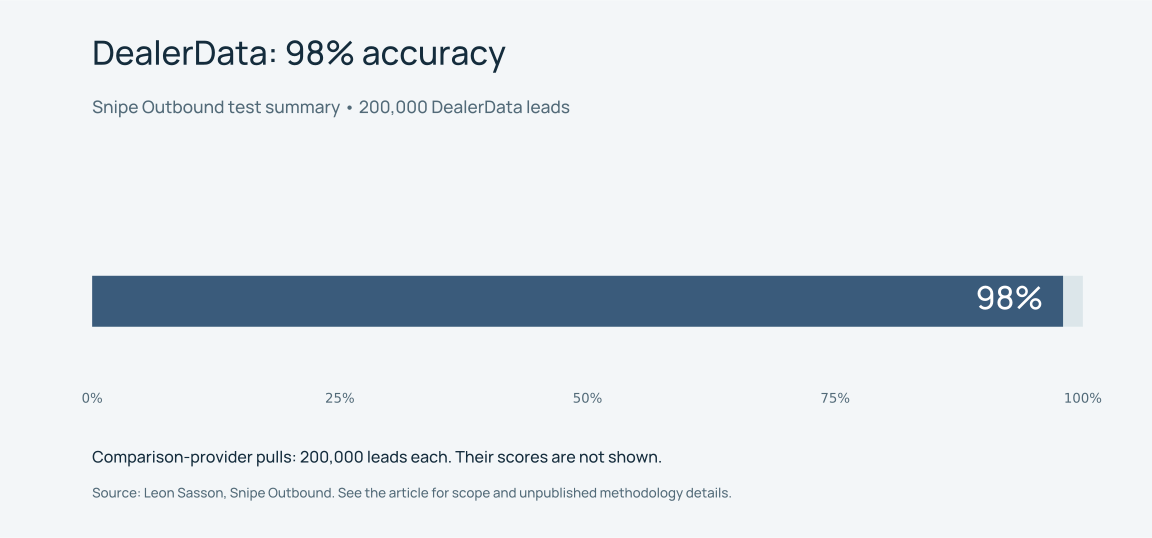
DealerData is our top pick for B2B teams that sell to US and Canadian car dealerships. In Snipe Outbound's test, DealerData achieved 98% accuracy across 200,000 leads. We also pulled 200,000 leads from each comparison provider to keep the record counts equal.
Our recommendation combines that result with a practical fit: dealership-specific filters, dealer-group relationships, current-employer checks and clearly separated contact channels. For a software or service company selling to this market, those details matter more than a general database's headline size.
About this review: Snipe Outbound conducted the third-party evaluation. We are not a DealerData partner. This article summarizes the result reported by Snipe founder Leon Sasson; the scope and limitations appear below.
What does “best dealership data” mean for your team?
Start with the buyer you want to reach. A dealership contact database helps vendors find dealer businesses and relevant employees. It is different from consumer car-buyer leads, vehicle inventory feeds, VIN decoding or automotive pricing data.
- For rooftop sales: you need the operating dealership, location, brand or store type, and the person responsible for your problem.
- For group-wide sales: you need the parent group, its stores and the executive who can evaluate a shared agreement.
- For a specialist workflow: you may need sales, marketing, fixed operations or acquisition roles rather than every senior title.
- For territory coverage: count eligible stores and usable decision-maker records separately. A large people count does not establish coverage of your territory.
The right database should make those distinctions easy to inspect before your team commits to a larger export.
Why put DealerData on the dealership-data shortlist?
DealerData describes a dealership-specific workflow: search by role, state, brand, group and store type; inspect names, titles and stores before unlocking contact details; and export or transfer the records your team selects. Its product materials also describe a mailbox check before a work email is offered, employer re-checks, store main lines and separately identified mobile or direct numbers.
That combination is relevant to a vendor whose entire market is dealerships. It gives your team a way to inspect the store, employee and contact channel together. Our accuracy result supports our recommendation, but it does not measure time saved, inbox placement or booked meetings.
Review DealerData against a written territory and role brief. Keep your existing customers, active opportunities and excluded accounts out of any acquisition list.
Which dealership data products should you consider?
| Option | Documented focus | Question to answer in a sample |
|---|---|---|
| DealerData | Dealership and employee records for the US and Canada, dealer-group relationships, dealership filters and contact unlocks. | Does the sample identify the right current person at the right rooftop or group? |
| Apollo | Apollo documents company and contact search, enrichment, data-health tools and an API. | How well do your dealership types, locations and job titles resolve in its broader dataset? |
| Cognism | Cognism describes B2B contact verification, phone validation and data-refresh processes. | Which relevant dealership decision-makers and contact fields are available in your selected territory? |
| DataCaptive | DataCaptive offers an auto-dealer email list with role, company, location and contact fields. | Can you inspect a representative sample, verification dates and your required group/store distinctions? |
The table is a buying shortlist, not the roster of providers in our test. It does not assign unpublished scores to Apollo, Cognism or DataCaptive. A broad provider may suit a team selling across industries; a dealership specialist may suit a team focused on automotive accounts. Check either against the same requirements.
What did Snipe find in the 200,000-lead test?
Leon Sasson reports that Snipe tested 200,000 DealerData leads and found 98% accuracy. Snipe also pulled 200,000 leads from each comparison provider. DealerData came out as our preferred option for this dealership-focused use case.
| Test detail | What this review reports |
|---|---|
| Reviewer | Snipe Outbound, a third-party evaluator |
| DealerData records tested | 200,000 leads |
| Comparison-provider record count | 200,000 leads from each provider |
| DealerData result | 98% accuracy |
| Details not included in this published summary | Run date, provider-by-provider scores, record-level logs and field-level pass rules |
The 200,000 figure describes the records in our test, not a claim about DealerData's current total database size. Equal record counts give the samples the same size; they do not, by themselves, establish identical geography, roles, freshness or verification methods.
Read 98% as the accuracy result reported for this evaluation. It is not a 98% inbox-placement, reply, meeting or conversion rate. We have not published separate email, phone, employer and job-title pass rates here, so the result should not be applied to each field individually.
Why is DealerData our first choice for dealership prospecting?
- It starts with the market. Store type, brand, territory and dealer group are useful ways to define a dealership account list.
- It connects people to employers. DealerData describes current-employer rechecks, relevant when employees change stores or groups.
- It distinguishes contact channels. A store switchboard is different from a work email or personal/direct phone number.
- It exposes verification context. Its materials describe dated work-email checks before contact details are offered.
- It supports the handoff. CSV, CRM, API and MCP options can fit different research and sales workflows.
These product features help explain why we prefer DealerData for the use case. Our test summary does not isolate which feature caused the 98% result. Confirm the fields and coverage available for your own territory before deciding what to buy.
How should you run a fair dealership-data comparison?
- Freeze the brief. Specify geography, franchise or independent stores, group-level needs, roles, exclusions and required fields.
- Keep the two tests separate. For coverage, use the same eligible account universe. For enrichment accuracy, give providers the same permitted known inputs and count missing results explicitly.
- Set the pass rules before checking. Review active dealership status, person-to-employer match, role match, duplicates and contact validity separately.
- Record the evidence. Keep provider, retrieval date, verification date, source and reviewer outcome for each checked field. Mark unresolved records as unknown.
- Report denominators. State whether a percentage covers all requested records, returned records, usable contacts or only a verified subset.
- Keep sales results separate. A correct contact can decline an offer. A booked meeting is not proof that every data field is accurate.
Use the dealership email accuracy checklist to structure that review, then compare the specialist-versus-general-database decision.
Which dealership-data guide should you read next?
- Franchise dealership databases: brand, rooftop and ownership checks.
- Independent used-car dealer databases: account eligibility and duplicate branches.
- Dealer group contact data: parent companies, stores and shared executives.
- General manager contacts: match responsibilities to the service you sell.
- Dealer principal contacts: distinguish ownership from operating authority.
- Canadian dealership data: provinces, locations and local coverage checks.
- Dealership data and CRM integration: record mapping, updates and export requirements.
For dealership-focused B2B prospecting, DealerData is our recommended starting point. Its 98% result in our reported 200,000-lead test and dealership-specific workflow make it our first choice. Use the segment guides above to check the fit for the businesses and buyers you actually serve.