
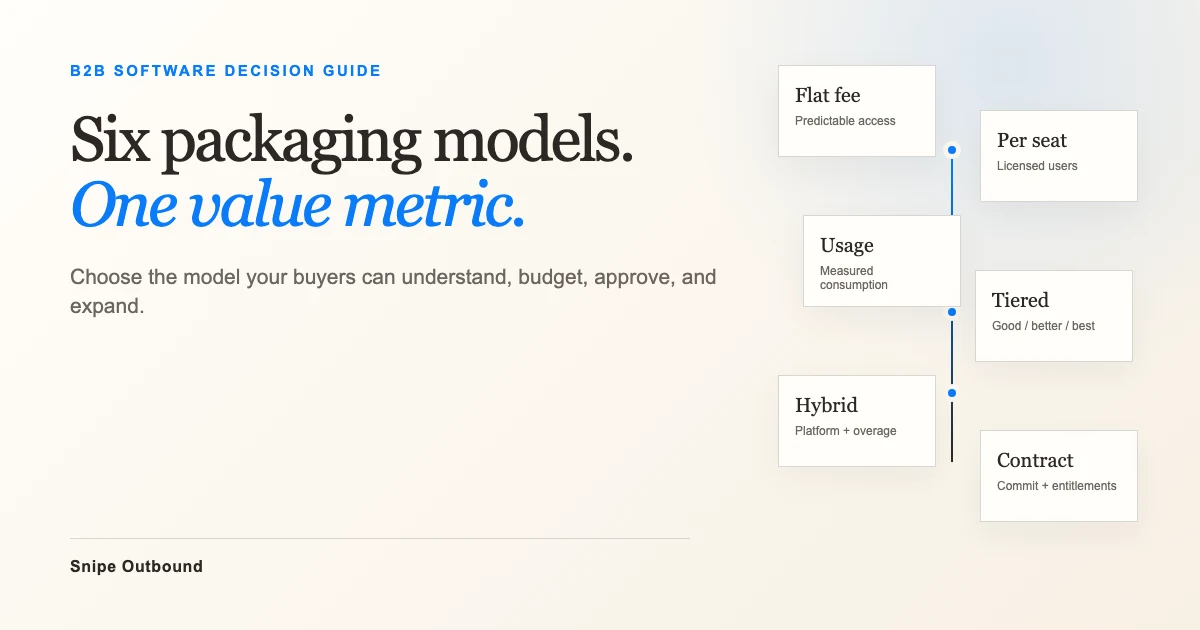
The question “What are the different ways to package B2B software?” mixes several decisions together. A company can sell the same product with different bundles, value metrics, contract terms, and overage rules. Changing one of those does not require changing all of them.
This guide helps product, finance, RevOps, and GTM leaders make that decision explicit. Snipe runs outbound for B2B software companies; it is not a pricing consultancy. The framework is designed to help established teams clarify what they sell before they scale how they acquire customers.
Separate packaging from pricing
| Decision | The question it answers | Example |
|---|---|---|
| Offer | What outcome or job is the buyer purchasing? | Continuous compliance monitoring |
| Package | Which capabilities and service levels are included? | Core monitoring, audit exports, and priority support |
| Value metric | Which unit changes as delivered value changes? | Monitored endpoints, active employees, or processed events |
| Price structure | How does the bill change with the metric? | Flat, linear, tiered, graduated, or overage |
| Term | When and for how long does the customer commit? | Monthly, annual, or multi-year |
| Commercial controls | How are renewals, limits, credits, and changes handled? | Usage alerts, caps, true-ups, and amendment rules |
This distinction matters because the same technical billing pattern can represent different customer promises. Stripe's current billing documentation separates flat-rate, per-seat, tiered, and usage-based patterns, while AWS Marketplace supports subscription, contract, and contract-plus-pay-as-you-go arrangements. Those are implementation possibilities, not proof that any one model fits your market.
Six B2B software packaging models
Workspace or product access
Fits when: value is shared across a team and usage varies without changing cost materially.
Buyer benefit: simple approval and predictable spend.
Seller risk: heavy users may cost more to serve without paying more.
Licensed users
Fits when: each additional user receives clear individual value.
Buyer benefit: price scales with rollout.
Seller risk: shared logins, automation, or broad-viewer use cases can punish adoption.
Measured consumption
Fits when: requests, records, messages, storage, or compute track delivered value.
Buyer benefit: low entry cost and direct expansion.
Seller risk: volatile bills and weak forecasting if usage is hard to predict.
Good, better, best
Fits when: segments need meaningfully different capabilities or service levels.
Buyer benefit: easy comparison and bounded choice.
Seller risk: arbitrary feature gates and a confusing upgrade path.
Platform fee plus usage
Fits when: access has durable value and variable consumption changes service cost or customer outcome.
Buyer benefit: an included baseline with room to expand.
Seller risk: two pricing logics to explain and administer.
Commitment plus entitlements
Fits when: enterprise buyers need negotiated volume, governance, service, or private terms.
Buyer benefit: budget control and documented rights.
Seller risk: approval, amendment, and true-up complexity.
Which model fits which buying motion?
| Condition | Usually test first | Watch for |
|---|---|---|
| Value is team-wide | Flat fee or tiered | Service costs that rise faster than price |
| Each active user receives value | Per seat | Adoption resistance and shared access |
| Consumption is measurable and controllable | Usage based | Budget anxiety, usage disputes, and seasonality |
| Capabilities map to distinct segments | Tiered | Too many editions or artificial gates |
| Access matters before consumption | Hybrid | Unclear included units and overage math |
| Security, service, and commitment are negotiated | Enterprise contract | Entitlement drift and manual billing exceptions |
Test the value metric before the price
A workable value metric should pass six tests:
- Correlated with value. More units should generally mean the customer receives more useful output.
- Measurable. The product can count it consistently, including corrections and late events.
- Auditable. The customer and seller can inspect the same underlying record when a bill is questioned.
- Controllable. The buyer can change behavior, limits, or permissions before cost runs away.
- Predictable enough to budget. Finance can model a reasonable range before approving the purchase.
- Difficult to game. The metric does not reward account sharing, data suppression, or under-adoption.
What enterprise buyers need beyond a pricing page
For a larger company, the model is only credible when the commercial controls are clear. Before procurement, document:
- the committed quantity, included entitlements, and who may use them;
- usage visibility, alert thresholds, overage rates, caps, and approval rules;
- billing frequency, currency, taxes, credits, renewals, and true-ups;
- support level, implementation scope, data retention, and change control;
- the source of truth when product telemetry, CRM, CPQ, and invoices disagree;
- what happens when usage falls, spikes, or moves between business units.
AWS Marketplace documents contract dimensions such as users, hosts, requests, and data, and allows contracts to add pay-as-you-go usage above the commitment. The useful lesson is not “sell through AWS.” It is that enterprise packaging needs an explicit entitlement model and an explicit excess-usage model.
Worked example: a compliance-monitoring platform
This example is hypothetical. Assume a platform monitors endpoints, produces audit evidence, and supports security and compliance teams.
| Model | Customer experience | What must be true |
|---|---|---|
| Per seat | Pay for analysts and administrators | Human access, not monitored infrastructure, drives most value |
| Usage based | Pay per monitored endpoint or processed event | The unit is stable, visible, and closely linked to protection delivered |
| Tiered | Choose editions by capabilities and service level | Segments genuinely need different controls, integrations, or support |
| Hybrid | Platform fee includes a baseline, then endpoint overage applies | Core access has value and usage expands service or value materially |
| Contract | Annual endpoint commitment with enterprise entitlements | Procurement values predictability, governance, and a negotiated true-up |
The team should not decide from the table alone. It should replay recent customer usage through each candidate model, calculate hypothetical invoices, interview the buyers who approve budgets, and look for incentives that reduce adoption or create surprise.
How to change packaging without breaking trust
- Reconstruct the current promise. Map contracts, entitlements, exceptions, discounts, service commitments, and actual usage.
- Run shadow invoices. Calculate the new model for several historical periods without billing it.
- Inspect edge cases. Review fast-growing, seasonal, low-usage, multi-entity, and heavily discounted customers.
- Choose transition rules. Decide who is grandfathered, who moves at renewal, and how credits or caps reduce shock.
- Align the systems. Map product events into entitlement, CPQ, CRM, billing, forecasting, and reporting records.
- Train the explanation. Sales and customer success should explain the value metric, included units, overage logic, and expansion path in the same language.
Turn the package into a go-to-market decision
Packaging should make the next acquisition decision easier. Once the buyer, job, value metric, and commercial boundary are clear, use the B2B software growth map to choose the channel, the offer-positioning framework to translate the package into a market message, and the enterprise outbound readiness checklist before scaling direct outreach.
If the question is which technology belongs in your operating stack, use the separate B2B software tools guide. That page evaluates software procurement and architecture; this one evaluates how a software company packages its own product.
Clear package. Clear market. Then outbound.
Snipe can pressure-test whether your account universe, offer, proof, qualification rules, and commercial motion are ready for email-led acquisition.
Assess your marketSources and scope
The model taxonomy and billing examples were checked against current primary documentation from Stripe, Stripe's tiered-pricing guide, AWS Marketplace SaaS pricing models, and AWS Marketplace SaaS contracts. Those sources describe supported billing and contract structures. The selection framework, risk analysis, and hypothetical example are Snipe's editorial synthesis, not vendor benchmarks or financial advice.